Types of Parkinson’s disease
 Reviewed by
 Parkinson’s disease is a progressive neurological condition that affects movement. Many symptoms of Parkinson’s disease are due to the loss of dopamine-producing nerve cells in a part of the brain called the substantia nigra.
The decrease in dopamine associated with Parkinson’s disease can cause motor symptoms such as tremor, bradykinesia (slowed movement), rigidity, and gait and balance problems.
Types of Parkinson’s disease include idiopathic and familial Parkinson’s disease. Other conditions with similar motor symptoms include atypical parkinsonism and secondary parkinsonism.
Primary parkinsonism
Parkinsonism is an umbrella term used to describe a group of movement symptoms, including tremor, slowness, and rigidity, that are associated with Parkinson’s disease and several other conditions.
Parkinsonism can be classified as primary or secondary.
- Primary parkinsonism: Caused by an underlying progressive neurological condition. Primary parkinsonism includes Parkinson’s disease and atypical parkinsonism.
- Secondary parkinsonism: Caused by certain medications, infections, or other health conditions.
Parkinson’s disease is the most common cause of primary parkinsonism, accounting for about 80% of cases. There are several subtypes of Parkinson’s disease, including idiopathic, familial, and early-onset Parkinson’s.
Idiopathic Parkinson’s disease
Most Parkinson’s cases are idiopathic, meaning the cause is unknown. Genetic and environmental factors may contribute to damage and loss of dopamine-producing brain cells.
Familial Parkinson’s
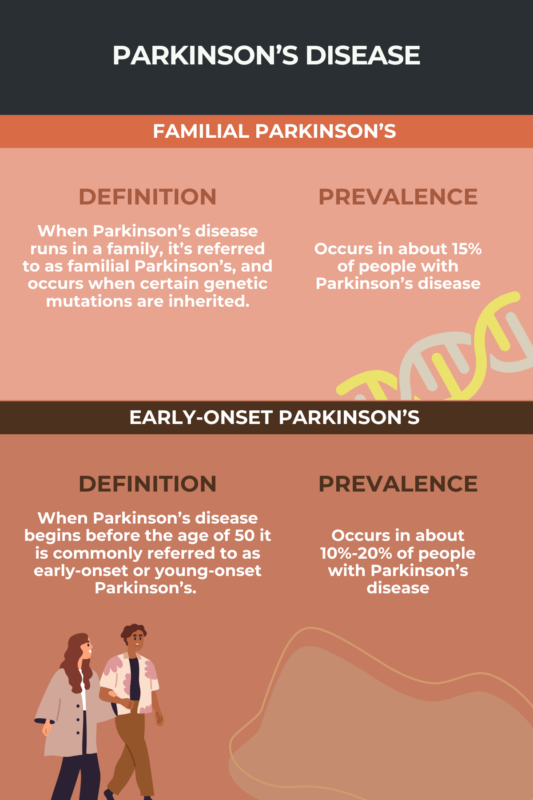
About 15% of people with Parkinson’s have a family history of the disease. When Parkinson’s runs in a family, it’s called familial Parkinson’s disease.
Familial Parkinson’s disease is usually associated with certain genetic variants that either can cause Parkinson’s outright or increase the risk of developing the disease. These mutations may be passed from parents to their biological children.
Familial Parkinson’s disease and idiopathic Parkinson’s disease share many of the same symptoms, though they tend to begin at an earlier age in people with familial Parkinson’s.
Early-onset Parkinson’s
Parkinson’s disease usually develops in the later decades of life — most people first start to notice symptoms when they are age 60 or older. In about 10% to 20% of cases, however, Parkinson’s begins before a person turns 50. These cases are commonly referred to as early-onset or young-onset Parkinson’s.
People with early-onset Parkinson’s more often have a family history and slower disease progression. Compared with older-onset cases, they are more likely to develop levodopa-related involuntary movements but less likely to have memory loss, confusion, or balance problems.
Atypical parkinsonism (Parkinson’s plus)
Atypical parkinsonism, also known as Parkinson’s plus, refers to a group of neurological conditions that cause motor symptoms similar to those seen in Parkinson’s disease. But atypical parkinsonism is also marked by other symptoms and biological changes that distinguish it from Parkinson’s.
Atypical parkinsonism generally responds poorly to levodopa, progresses faster, and has a poorer prognosis than Parkinson’s disease.
Treatment for atypical parkinsonism focuses on easing specific symptoms, maintaining independence, and reducing the risk of complications.
Dementia with Lewy bodies
Dementia with Lewy bodies (DLB) is a form of dementia characterized by toxic clumps of the protein alpha-synuclein in the brain. These toxic protein clumps, called Lewy bodies, also develop in the brains of people with Parkinson’s disease.
In addition to parkinsonism, DLB can cause:
- cognitive difficulties
- changes in alertness and attention
- trouble multitasking and problem solving
- visual hallucinations
- sleep disturbances
Under the “one-year rule,” dementia that develops before or within one year of motor symptoms is generally classified as dementia with Lewy bodies (DLB). If dementia develops more than one year after motor symptoms begin, it is generally classified as Parkinson’s disease dementia.
Progressive supranuclear palsy
Progressive supranuclear palsy (PSP) is a neurological disorder caused by nerve damage in the area of the brain that controls movement and thinking.
PSP shares some symptoms with Parkinson’s disease, such as rigidity, cognitive changes, and sleep problems. However, people with PSP tend to have additional symptoms, including abnormal eye movements and a tendency to lean backward (axial rigidity).
Problems with speech and swallowing are also more common and usually more severe in PSP than in Parkinson’s, whereas tremor is much less common.
Whereas Parkinson’s is marked by abnormal clumps of the protein alpha-synuclein in the brain, PSP is characterized by toxic clumps of another protein called tau.
Corticobasal degeneration
Corticobasal degeneration is a brain disease that can cause corticobasal syndrome (CBS), a group of symptoms also caused by other neurological diseases. CBS can cause Parkinson’s-like rigidity, tremor, and balance problems, typically affecting one side more than the other.
People with corticobasal degeneration may have difficulty using their affected limbs or may feel that their arms or legs move independently.
As in PSP, corticobasal degeneration is marked by toxic clumps of the protein tau in the brain. There is notable clinical overlap between corticobasal degeneration and PSP, which can sometimes make it difficult to distinguish between them. In some cases, a person may have features of both conditions.
Multiple system atrophy
Multiple system atrophy (MSA) causes Parkinson’s-like motor symptoms, as well as greater impairment of the autonomic nervous system, which controls functions such as breathing, sweating, and digestion.
This can lead to symptoms such as:
- dizziness or fainting
- constipation
- loss of bladder or bowel control
- inability to sweat
- sexual problems
- trouble controlling emotions
MSA tends to progress much faster than Parkinson’s disease. As in Parkinson’s disease, MSA is typically marked by toxic clumps of the protein alpha-synuclein in the brain.
Secondary parkinsonism
Some neurological disorders caused by medications, infections, or other conditions can cause Parkinson’s-like symptoms. People with such symptoms are said to have secondary parkinsonism, as their Parkinson’s symptoms occur secondary to other health problems.
Some types of secondary parkinsonism may improve once the underlying cause is treated.
Drug-induced parkinsonism
Some medications can cause Parkinson’s-like symptoms as a side effect, which is known as drug-induced parkinsonism. After primary Parkinson’s disease, this is the most common type of parkinsonism.
Drug-induced parkinsonism is typically a side effect of medications that affect dopamine levels in the brain.
Antipsychotics, also known as neuroleptics, are associated with the highest risk of drug-induced parkinsonism. These medications are given to help control psychosis.
Other medications have been associated with drug-induced parkinsonism, though the risk of this side effect is generally lower with most of these therapies. These include certain:
- antidepressants
- antibiotics
- antihistamines
- nausea treatments
- anti-seizure therapies
- medications to regulate blood pressure or heart rate
Usually, symptoms of drug-induced parkinsonism will ease within a few weeks after a patient stops taking the medication. In rare cases, however, symptoms can persist for months or even years after stopping the medication.
Vascular parkinsonism
Vascular parkinsonism arises when problems with blood flow in the brain lead to brain damage that mimics symptoms of Parkinson’s disease. Small strokes are the main cause of vascular parkinsonism.
This form of parkinsonism usually affects the lower limbs more than the arms, which can cause significant walking and balance problems. It tends to progress more slowly than other types of parkinsonism.
Treatment for vascular parkinsonism focuses on easing movement symptoms, improving walking and balance through physical or occupational therapy, and reducing stroke risk.
Normal pressure hydrocephalus
The brain and spinal cord are surrounded by fluid known as the cerebrospinal fluid (CSF). Normal pressure hydrocephalus develops when the CSF doesn’t drain properly, causing swelling in the brain that leads to problems with brain function. The result can be symptoms similar to those of Parkinson’s disease or other neurological disorders, such as Alzheimer’s.
Normal pressure hydrocephalus is typically treated with a procedure to drain CSF that’s aimed at relieving pressure on the brain.
Infections, toxins, and trauma
Several types of infections in the brain can cause Parkinson’s-like symptoms. Infections known to cause these symptoms include:
- influenza, which causes the flu
- Epstein-Barr virus, which causes infectious mononucleosis, or “mono,” as well as other nonspecific diseases
- Japanese encephalitis virus
- West Nile virus
- Herpes zoster, which causes chickenpox and shingles
- Human immunodeficiency virus
Toxins that cause damage to the brain may also result in parkinsonism. For example, parkinsonism is a common complication of carbon monoxide poisoning. Tumors in the brain or physical injury to the brain may also cause Parkinson’s-like symptoms.
How doctors distinguish between Parkinsonism types
Because parkinsonism disorders cause many of the same symptoms, getting an accurate diagnosis can be difficult. No single test can diagnose parkinsonism.
Medical history and physical examination
A neurologist or movement disorder specialist reviews a person’s symptoms, medical conditions, medication use, family history, and lifestyle factors.
They also assess movement, muscle stiffness, tremor, and balance. A Parkinson’s disease diagnosis requires bradykinesia (slowed movement) plus rigidity, a resting tremor, or both.
Levodopa response test
A person’s response to levodopa can help support a diagnosis, but it does not always clearly distinguish Parkinson’s disease from other forms of parkinsonism.
Levodopa typically improves motor symptoms in Parkinson’s disease but offers limited or no benefit in atypical or secondary parkinsonism, with some exceptions.
Doctors may prescribe a trial of levodopa to assess symptom response alongside other clinical findings.
Diagnostic tests
A neurologist can perform several tests to help diagnose parkinsonism:
- Genetic tests: A genetic test can identify genetic variants linked to Parkinson’s disease in people with a family history of the condition.
- DaTscan: A DaTscan is an imaging technique that shows the dopamine system in the brain. Reduced dopamine function in the area of the brain that controls movement could be a sign of Parkinson’s disease or other forms of atypical parkinsonism.
- Imaging tests: A neurologist can request brain imaging tests, such as MRI or CT scans, to look for other potential causes of parkinsonism, such as brain tumors or hydrocephalus.
A neurologist can recommend ways to manage symptoms and address underlying causes or medication triggers.
Parkinson's News Today is strictly a news and information website about the disease. It does not provide medical advice, diagnosis, or treatment. This content is not intended to be a substitute for professional medical advice, diagnosis, or treatment. Always seek the advice of your physician or other qualified health provider with any questions you may have regarding a medical condition. Never disregard professional medical advice or delay in seeking it because of something you have read on this website.