Bradykinesia in Parkinson’s disease
 Reviewed by
Bradykinesia is abnormal slowness of movement. This symptom is not a standalone condition, but rather one of the cardinal motor symptoms of Parkinson’s disease, alongside tremor, rigidity, and postural instability. These symptoms develop because Parkinson’s involves changes to the parts of the brain that affect movement.
Parkinson’s disease is a neurological disorder in which nerve cells progressively die, resulting in the loss of dopamine, a chemical messenger that relays information between nerve cells. Reduced dopamine levels affect the body’s motor functions, leading to movement disorders such as bradykinesia.
Bradykinesia in Parkinson’s disease can cause slowness when walking, reduced arm swing, and difficulty initiating movement, and it affects the vast majority of people with the disease. Treatment focuses on medications that affect dopamine levels in the brain, such as levodopa. Management can also involve exercise, deep brain stimulation, and physical or occupational therapy.
Bradykinesia is one of several movement disorders in Parkinson’s, alongside hypokinesia and akinesia. Hypokinesia is a reduction in the size and amplitude of movement, while akinesia is the difficulty or failure in initiating voluntary movement. Some medical resources, however, do not cleanly distinguish between these movement disorders.
Subtle signs and everyday impacts of bradykinesia
In the earlier stages of Parkinson’s disease, slowed movement is often subtle and confined to one side of the body. Symptoms might manifest as slightly slower performance on one side or a reduced arm swing when walking, affecting only one arm. Because these changes are so gradual at first, a caregiver or loved one may notice them first and prompt a visit to the doctor.
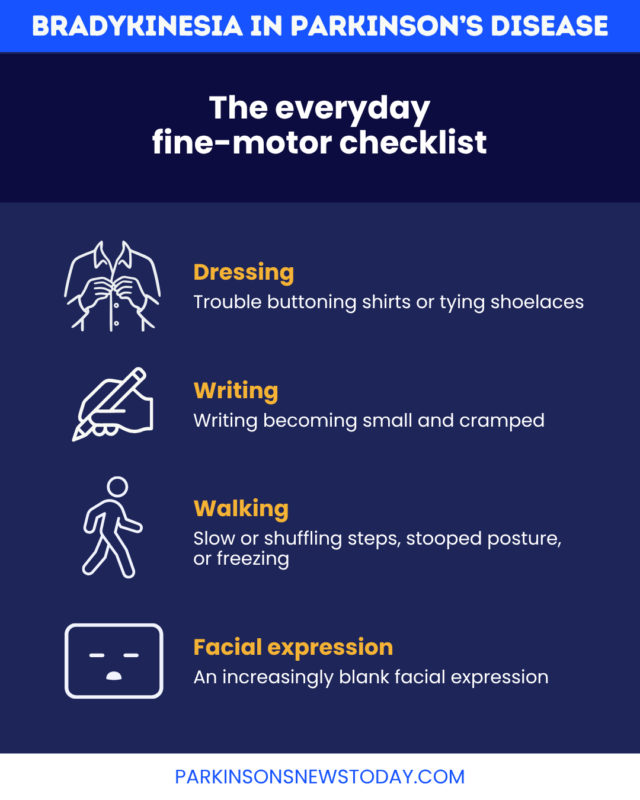
Difficulties with fine motor tasks can be among the early signs of bradykinesia. Simple actions such as buttoning a shirt, cutting food, or brushing teeth may take noticeably longer.
These effects on fine motor skills tend to become more pronounced as Parkinson’s disease progresses. Individuals with this condition may find that bradykinesia makes daily activities noticeably harder. At this stage, the symptom may affect both sides of the body and can lead to:
- smaller handwriting
- diminished facial expressions
- softer speech
Mobility and gait changes
A one-sided reduction in arm swing during walking can appear as a very early sign of gait disturbance, often showing up before any changes in leg movement become noticeable. Over time, individuals experience a stooped posture, reduced arm swing, and small, shuffling steps.
In the later stages of Parkinson’s disease, bradykinesia can cause profound changes to an individual’s daily life, making self-care difficult. During periods in which medication is less effective, individuals may become almost completely immobile. People with Parkinson’s may, at this point, experience more frequent freezing during transitions, such as when rising from a chair or attempting to move.
Sensory perception
Evidence indicates that proprioception, the body’s sense of where a limb sits in space, can become less reliable as a result of Parkinson’s disease. Studies show that position sense in the forearm is less sensitive in people with Parkinson’s. Changes in a person’s sense of smell can often precede other symptoms of Parkinson’s.
Sensory changes in Parkinson’s disease can affect bradykinesia. For instance, people with Parkinson’s might not notice that their movements are slower because they cannot reliably gauge their speed. This lack of sensory awareness makes it challenging for individuals to adjust or correct their movement difficulties.
Scroll horizontally to view all columns -->
| Consequence of bradykinesia | Description |
|---|---|
| Reduced arm swing | Smaller swing of an arm, usually affecting only one side of the body |
| Fine motor changes (early stage) | These changes can manifest as difficulties with buttoning shirts, cutting food, or brushing teeth |
| Fine motor changes (later stage) | Handwriting becoming smaller (micrographia in Parkinson’s), facial expression diminishing, and speech becoming softer |
| Mobility and gait changes | More pronounced differences in arm swing, stooped posture, and small or shuffling steps |
| Freezing | Can occur when trying to move or when attempting to get off a chair |
Diagnosis and clinical motor testing
Diagnosing bradykinesia in Parkinson’s disease starts with a visit to a neurologist, preferably one specializing in movement disorders.
During a Parkinson’s evaluation, the specialist takes a detailed medical history and performs a neurological examination. The clinician reviews how symptoms have progressed over time and the patient’s response to Parkinson’s medications. A comprehensive review of current and past medications is also essential, because certain drugs can cause symptoms that mimic Parkinson’s.
Ruling out these secondary causes helps prevent misdiagnosis, which remains a significant risk. Even experienced neurologists misdiagnose Parkinson’s in roughly 10% to 25% of cases, particularly when symptoms are still mild during the earlier stages of the disease. Nonspecialists exhibit even higher rates of misdiagnosing Parkinson’s disease.
Bradykinesia motor tests are a core component of the specialist physical exam. The specialist asks the patient to perform repeated movements, such as:
- tapping fingers and thumbs together
- opening and closing hands
- tapping feet
As these actions take place, the clinician evaluates the patient for slowness, hesitation, brief freezes mid-motion, and slower or smaller repetitive movements. Sufficient evidence of these motor problems may be attributed to bradykinesia.
Under widely used diagnostic criteria, bradykinesia must be present for a diagnosis of Parkinson’s disease, along with at least resting tremor, or stiffness or rigidity.
Diagnostic imaging can play a supporting role in the diagnosis of Parkinson’s. No single lab test or scan can confirm the disease on its own. However, MRI scans, DaTscans, and blood work can help rule out other conditions.
The U.S. Food and Drug Administration approved the DaTscan imaging technique in 2011. This technology allows clinicians to examine detailed images of the brain’s dopamine system.
Doctors typically suggest a DaTscan only when the diagnostic picture remains unclear. For instance, DaTscans can be helpful when an individual presents with tremors without obvious bradykinesia, or exhibits Parkinson’s-like motor symptoms that affect both sides of the body equally.
Because early Parkinson’s can be hard to confirm in a single visit, a follow-up exam several months later allows the specialist to assess how symptoms have evolved. A definitive diagnosis can sometimes take six to 12 months of specialist observation.
Treatments for bradykinesia
Treating bradykinesia involves addressing its underlying cause, which for most individuals is Parkinson’s disease.
Treatment and management of Parkinson’s disease typically involves a combination of exercise, physical therapy, and medications that boost dopamine levels in the brain.
Pharmacological therapies
Levodopa for bradykinesia remains the gold-standard approach for treating Parkinson’s disease. This medication restores dopamine levels in the brain, improving movement speed and coordination.
Dopamine agonists and MAO-B inhibitors are effective alternatives in early-stage disease. However, they tend to produce less significant easing of bradykinesia than levodopa does.
When medications stop controlling symptoms adequately, clinicians may consider deep brain stimulation. This treatment option involves surgically implanting electrodes into the brain to send electrical impulses that interrupt the brain signals causing bradykinesia.
Physical therapy and exercise
Physical therapy for bradykinesia can play an important role in maintaining functional, day-to-day mobility for people with Parkinson’s disease. For instance, high-intensity programs such as LSVT BIG can train people with Parkinson’s to make deliberately large movements. Research has shown that bradykinesia can be eased with LSVT BIG sessions, with positive effects persisting beyond the training period.
Strength training using resistance bands, hand-held weights, and other gym equipment can also help improve muscle strength and function. Similarly, stretching may help to address the stiffness and tension that accompany Parkinson’s. These changes can improve gait for people with Parkinson’s, even when it has been altered by bradykinesia.
Occupational therapy and daily lifestyle aids
Bradykinesia can make day-to-day activities difficult. Getting in and out of bed, moving around the house, or entering and exiting a vehicle can all be challenging.
An occupational therapist can evaluate the specific daily challenges faced by individuals with Parkinson’s and collaborate with them to develop customized plans. These plans, which may include specific movement guidance and home modification recommendations, can help individuals living with the effects of bradykinesia to navigate daily life with more ease and comfort.
Several practical tips can help people with Parkinson’s manage the effects of bradykinesia. These include breaking complex tasks and movements into simpler steps, allowing extra time for activities, and using verbal and auditory cues to help guide movement.
Parkinson's News Today is strictly a news and information website about the disease. It does not provide medical advice, diagnosis, or treatment. This content is not intended to be a substitute for professional medical advice, diagnosis, or treatment. Always seek the advice of your physician or other qualified health provider with any questions you may have regarding a medical condition. Never disregard professional medical advice or delay in seeking it because of something you have read on this website.