
 Fact-checked by
  Discussion
Nuplazid (pimavanserin) for Parkinson’s disease
What is Nuplazid for Parkinson’s Disease?
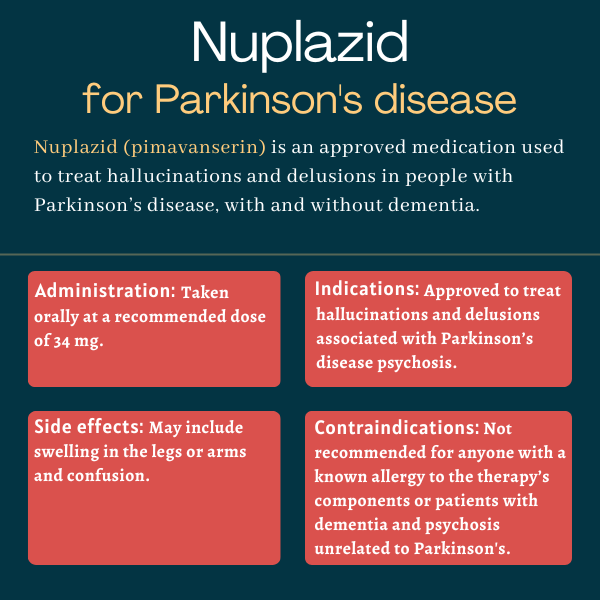
Nuplazid (pimavanserin) is an oral medication approved in the U.S. to treat hallucinations and delusions associated with Parkinson’s disease psychosis.
With hallucinations, people perceive things that aren’t real and can happen any time a person is awake. Delusions are irrational or illogical beliefs that lack a basis in reality.
The medicine, which is the only prescription medication approved in the U.S. for this specific indication, was developed by Acadia Pharmaceuticals. It’s not been approved in Europe, Japan, Canada, or China.
Therapy snapshot
Scroll horizontally to view all columns -->
| Brand name: | Nuplazid |
| Chemical name: | pimavanserin |
| Usage: | Used to treat hallucinations and delusions associated with Parkinson’s disease psychosis |
| Administration: | Oral tablets or capsules |
How does Nuplazid work?
Parkinson’s symptoms are recognized by most people as tremors, limb stiffness, impaired balance, and slow movement. Over the course of the disease, however, up to 60% of all patients are affected by psychosis, which causes them to see, hear, or experience things that aren’t real (hallucinations), or believe things that aren’t true (delusions).
Nuplazid is designed to ease those symptoms by targeting serotonin receptors called 5HT2A receptors. The medication is an inverse agonist of these receptors, meaning it binds to the target like a ligand — a molecule that initiates a physiological response — but induces the opposite pharmacological response.
Serotonin receptors are found throughout the nervous system and mediate the transmission of signals between nerve cells. The 5HT2A receptor has been implicated in mental disorders, but in ways that are still not clearly understood.
Parkinson’s is caused by the progressive loss of nerve cells responsible for making dopamine, a chemical messenger that nerve cells use to communicate with each other. Because most antipsychotics are designed to block dopamine signaling, which can exacerbate motor symptoms in people with Parkinson’s, these drugs are contraindicated in such patients.
Nuplazid, however, has no binding affinity for dopamine receptors, so it doesn’t interfere with dopaminergic therapies and it doesn’t bind to other receptors commonly targeted by antipsychotics. This means the therapy won’t affect motor skills.
Who can take Nuplazid?
Nuplazid was approved by the U.S. Food and Drug Administration (FDA) in April 2016 to treat hallucinations and delusions associated with Parkinson’s disease psychosis. This marked the first and only approval of a medication for that indication in the U.S.
The therapy can be used in people with and without dementia.
Who should not take Nuplazid?
Nuplazid is contraindicated, or not recommended for, anyone with a history of allergic reactions to pimavanserin or any of its ingredients.
The prescribing information for Nuplazid has a boxed warning that notes that elderly patients with dementia-related psychosis have an increased risk of death when given antipsychotic medications such as Nuplazid. Therefore, it’s not indicated for anyone with dementia and psychosis, unless their hallucinations and delusions are clearly related to Parkinson’s.
Nuplazid also should be avoided for patients with certain heart conditions or who are receiving medications that influence heart rhythm. Caution is also recommended in people with severe kidney impairment and kidney failure.
How is Nuplazid administered in Parkinson’s?
Nuplazid is available as capsules or tablets that are taken orally once daily. Regarding pimavanserin:
- Nuplazid capsules contain 34 mg of the active ingredient and are opaque white and light green with “PIMA” and “34” printed in black
- Nuplazid tablets have a 10 mg strength and are orange, round, and debossed with a “P” on one side and a “10” on the other side.
Nuplazid’s recommended dose is 34 mg, taken orally once daily, without the need for gradual dose increases. However, if patients are taking strong inhibitors of the CYP3A4 enzyme — which is involved in pimavanserin’s metabolism — a 10 mg dose is recommended as one tablet once daily.
The medication can be taken with or without food. While capsules can be taken whole, they include a sprinkle formulation for some patients, especially those who have difficulty swallowing.
With this, the contents of Nuplazid capsules can be opened and the entire contents sprinkled over a tablespoon of easily swallowed food, such as applesauce, yogurt, pudding, or a liquid nutritional supplement. The mixture should be swallowed immediately, without chewing.
Patients don’t need to adjust their carbidopa and levodopa dose when taking Nuplazid.
Nuplazid in clinical trials
The approval of Nuplazid was mainly based on data from a six-week Phase 3 trial (NCT01174004), called ACP-103-020, wherein 199 patients were randomly assigned to either receive Nuplazid or a placebo once daily. Additional Phase 3 trials and an open-label extension also supported the benefits of the medication in people with Parkinson’s-related psychosis.
ACP-103-020 trial
ACP-103-020 enrolled people with Parkinson’s disease, with or without dementia, who had frequent psychotic symptoms (hallucinations and/or delusions) that began after their Parkinson’s diagnosis and were severe enough to warrant treatment with an antipsychotic medication.
Most patients were already taking Parkinson’s disease medications when they joined the study and these medications had to remain stable for at least one month before the study began and throughout its duration.
The trial’s main goal was to evaluate Nuplazid’s antipsychotic benefit, using the Parkinson’s disease-adapted Scale for the Assessment of Positive Symptoms (SAPS-PD) in all patients who took at least one dose of it.
Nuplazid performed significantly better than the placebo in reducing the frequency and intensity of hallucinations and delusions over the six-week trial. Patients on Nuplazid saw a mean 37% reduction (improvement) in SAPS-PD scores, more than double than the 14% improvement seen in placebo-treated patients.
These improvements occurred without impairing motor function.
Other Phase 3 trials and open-label extension
Two additional six-week Phase 3 studies, called ACP-103-012 (NCT00477672) and ACP-103-014 (NCT00658567), also evaluated multiple doses of Nuplazid versus a placebo in more than 400 Parkinson’s patients experiencing visual or auditory hallucinations and/or delusions.
The studies showed that the 34 mg dose was well tolerated and didn’t have a negative impact on motor or cognition-related function.
An open-label extension (NCT00550238) was conducted to evaluate the long-term safety and tolerability of Nuplazid in these patients. The trial enrolled those who had participated in one of the three prior six-week Phase 3 studies.
Results showed Nuplazid could ease symptoms for up to 10 weeks — six weeks in the double-blind trials, plus four in the OLE. Improvements in psychosis scores were more pronounced in people who had previously been on a placebo in the original trials, but those who were always on Nuplazid also continued to see score reductions in the extension study.
Common side effects of Nuplazid
The common side effects of Nuplazid reported in clinical trials include:
- swelling in the legs or arms
- confusion.
Increased mortality in older patients with dementia-related psychosis
Nuplazid’s prescribing information carries a boxed warning noting that antipsychotic drugs can raise the risk of death from any cause in elderly patients with dementia-related psychosis. Therefore, the medication is not approved for people with dementia who experience psychosis unless their hallucinations and delusions are associated with Parkinson’s disease.
Heart conditions
Treatment with Nuplazid can lead to QTc prolongation — a medical term that describes an extension of the interval between the heart contracting and relaxing. Therefore, it should be avoided in patients with known QTc prolongation or who are taking medications that can exacerbate this heart rhythm condition.
These include certain medications used to treat abnormal heart rhythms, certain antipsychotic medications and certain antibiotics. Patients should inform their healthcare providers about all the medicines they are taking or have recently taken.
Nuplazid should also be avoided by patients with a history of cardiac arrhythmias — abnormal heart rhythms — or other problems that can result in an abnormal heart rhythm and/or lead to sudden cardiac death.
Use in pregnancy and breastfeeding
No information on using Nuplazid during pregnancy in humans exists, but animal studies have shown that exposure to it during pregnancy and lactation may be toxic and reduce pup survival. Therefore, using it during pregnancy should be carefully considered and the potential benefits should be weighed against risks to both the mother and baby.
There’s no information regarding the presence of Nuplazid in human breast milk, its effects on the breastfed infant, or its effects on milk production. Patients who are or plan to become pregnant, and those who are nursing or plan to breastfeed, should discuss this issue with their healthcare provider.
Parkinson’s News Today is strictly a news and information website about the disease. It does not provide medical advice, diagnosis, or treatment. This content is not intended to be a substitute for professional medical advice, diagnosis, or treatment. Always seek the advice of your physician or other qualified health provider with any questions you may have regarding a medical condition. Never disregard professional medical advice or delay in seeking it because of something you have read on this website.
Related articles
-
Discussion
-
 Discussion
-
 Discussion
-
 Discussion
-
 Discussion
-
 Discussion