Nourianz (istradefylline) for Parkinson’s disease
 Fact-checked by
 What is Nourianz for Parkinson’s disease?
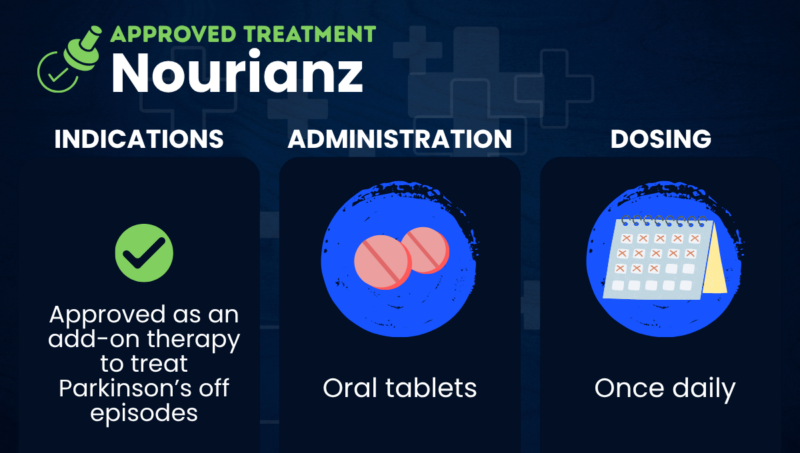
Nourianz (istradefylline) for Parkinson’s disease is an oral add-on therapy used to manage off episodes — periods when symptoms return between medication doses — in people taking carbidopa and levodopa.
Parkinson’s occurs when nerve cells that manufacture dopamine, a key signaling molecule in the brain, gradually die, leading to a combination of motor and nonmotor symptoms.
The neurodegenerative disease is commonly treated with levodopa — a molecule that the body can transform into dopamine to replace that lost in Parkinson’s — combined with carbidopa, which helps more levodopa reach the brain. However, over time, many people taking this combination begin to experience off episodes.
Nourianz is designed as an add-on to ease this wearing-off effect. Researchers don’t entirely understand how Nourianz works, but believe it acts on another brain messenger molecule called adenosine.
If dopamine acts like a gas pedal, encouraging movement, adenosine acts like a brake. With dropping dopamine levels in Parkinson’s, these systems become unbalanced and adenosine becomes relatively overactive, inhibiting movement.
Nourianz is an adenosine A2A receptor antagonist, meaning it inhibits adenosine signaling by blocking the receptor protein it normally binds with to exert its effects. This may help lift the brakes, bringing adenosine into balance with dopamine and enabling easier movement.
Kyowa Kirin Pharma developed Nourianz and sells it in the U.S. and Japan (where it is marketed as Nouriast). No generics of Nourianz are currently available.
Therapy snapshot
| Brand name | Nourianz |
| Chemical name | Istradefylline |
| Usage | Used as an add-on therapy to manage off episodes in Parkinson’s disease |
| Administration | Oral tablets |
Who can take Nourianz?
Nourianz is approved in the U.S. as an add-on to carbidopa and levodopa for adults with Parkinson’s disease who are experiencing off episodes.
The prescribing information for Nourianz doesn’t list any contraindications, or reasons to avoid using the medication. However, it is generally not recommended for people who:
- have major psychotic disorders, due to a risk of exacerbating symptoms
- have severe liver disease, which can increase the body’s exposure to Nourianz
- also use medications that strongly activate the enzyme CYP3A4 (including some antibiotics and anticonvulsants), which can decrease the body’s exposure to Nourianz
How is Nourianz administered?
Nourianz comes as film-coated oral tablets, taken once daily with or without food. For most people, the recommended Nourianz dosage is 20 mg once daily. The dose may be increased to a maximum of 40 mg daily based on individual need and tolerability. However, certain individuals should not take more than 20 mg of Nourianz in a day, including people who:
- have moderate liver impairment
- are also using medications that strongly block CYP3A4 (including some antibiotics and antifungals), which can increase the body’s exposure to Nourianz
For people who smoke 20 or more cigarettes daily, or use an equivalent amount of another tobacco product, the recommended Nourianz dosage is 40 mg once daily. Tobacco smoking lowers the body’s exposure to Nourianz, which may decrease its effectiveness.
Nourianz in clinical trials
The approval of Nourianz was based on data from four Phase 2 and Phase 3 clinical trials that collectively involved more than 1,000 people with Parkinson’s who were experiencing at least two hours of off time per day despite treatment with levodopa and other standard Parkinson’s medicines.
Participants received Nourianz or a placebo for 12 weeks, or about three months. The main goal was to evaluate changes in daily off time. Data from these studies showed that across all tested doses, Nourianz reduced daily off time relative to placebo. Specifically:
- A Phase 2 trial (NCT00456586) in the U.S. and Canada found that 40 mg Nourianz decreased daily off time by almost 7% compared with placebo — a nearly threefold improvement.
- A Phase 3 trial (NCT00199407) in the U.S. found that 20 mg Nourianz decreased daily off time by almost 5% compared with placebo — a nearly twofold improvement.
- A Phase 2 trial (NCT00455507) in Japan found that Nourianz decreased daily off time compared with placebo — by 0.65 hours with 20 mg and by nearly one hour with 40 mg.
- A Phase 3 trial (NCT00955526) in Japan found that both 20 mg and 40 mg of Nourianz decreased off time relative to placebo by around 45 minutes per day.
Pooled analyses of more than 2,700 participants from these and other studies showed that both doses of Nourianz significantly decreased daily off time while increasing on time without troublesome dyskinesia, meaning periods when symptoms were effectively controlled without bothersome involuntary movements. Dyskinesia can be a side effect of Nourianz and levodopa.
The medication also eased motor disability regardless of which symptoms were most dominant — either tremor or postural instability and gait difficulty.
Nourianz side effects
The most common side effects of Nourianz include:
- dyskinesia (involuntary movements)
- dizziness
- constipation
- nausea
- hallucinations (perceiving things that aren’t there)
- insomnia
Nourianz can cause new dyskinesia or worsen existing dyskinesia associated with levodopa treatment.
The medication also comes with warnings that it could cause new or worsening hallucinations and psychotic-like behavior, as well as problems with impulse control or compulsive behaviors. If these occur, doctors may recommend reducing the dosage or stopping treatment.
Parkinson's News Today is strictly a news and information website about the disease. It does not provide medical advice, diagnosis, or treatment. This content is not intended to be a substitute for professional medical advice, diagnosis, or treatment. Always seek the advice of your physician or other qualified health provider with any questions you may have regarding a medical condition. Never disregard professional medical advice or delay in seeking it because of something you have read on this website.