
Guest Voice: How Parkinson’s gave me a new purpose in life
What began as an effort to problem-solve has grown into a goal of helping others
Written by |

I was diagnosed with Parkinson’s disease in 2019 at the age of 55, after my wife noticed a tremor in my left hand. Like many people, I left my doctor’s appointment with more questions than answers. My instinct was to try to maintain a sense of normalcy by following medical advice, sticking to my routines, and not focusing too much on the diagnosis.
At the time, I thought that meant I was managing Parkinson’s. Looking back, I realize I was mostly reacting to it.
At first, that approach felt reasonable. I followed my doctor’s guidance, took my medications, and tried not to dwell on what might come next. But over time, I began noticing small changes. It became clear that simply ignoring Parkinson’s wasn’t a neutral choice — it meant letting the disease set the pace. That realization was a turning point.
A sense of direction
My professional background is in engineering and technology, where solving complex problems is part of the job. Eventually, I started approaching Parkinson’s with the same mindset. Instead of wondering what the disease might do next, I began asking a different question: What can I do about it?
I started reading research, learning about exercise science, and exploring lifestyle factors that might influence how people live with Parkinson’s. I participated in research studies, spoke with doctors and researchers, and connected with others who were living with the disease. I explored different approaches and looked into a wide range of options. In many ways, I began treating Parkinson’s like a problem that required investigation, persistence, and adaptation.

Physical wellness became an important part of Steve Yellen’s Parkinson’s journey, and Spartan obstacle course races are part of his training. (Courtesy of Steve Yellen)
One of the most important shifts for me was realizing that Parkinson’s didn’t eliminate my ability to influence my future — it just changed how I needed to approach it.
One of the first things I learned was the growing evidence around exercise and its potential impact on disease progression. That discovery reshaped my daily routine. Exercise was no longer optional. It became essential.
To stay motivated, I started setting goals. Over time, those goals led me to participate in athletic events, including triathlons, Spartan obstacle course races, and even running up the Empire State Building stairs. These weren’t about competition or proving anything to anyone — they simply gave my training focus and purpose and helped me stay engaged over the long term.
Of course, exercise was only one part of the equation. As I became more physically engaged, I also started thinking more broadly about wellness. Nutrition, sleep, stress management, and recovery all became part of the picture. None of these are cures, but together they could help tilt the playing field in my favor. The more intentional I became with these choices, the more I felt I was influencing my own trajectory instead of waiting for Parkinson’s to dictate it.
Over time, that engagement expanded beyond my personal routine. I became involved in advocacy efforts related to Parkinson’s research and policy, and I participated in studies designed to help scientists better understand the disease. Those experiences reinforced an important lesson: Progress depends on individuals being willing to step forward, participate, and share their experiences.
Along the way, something unexpected happened. I realized I wasn’t just trying different strategies — I was gradually building a framework for how to live with Parkinson’s. Friends and others in the Parkinson’s community started asking what I was doing and how I was thinking about the disease. Sharing those experiences became just as meaningful as the actions themselves.
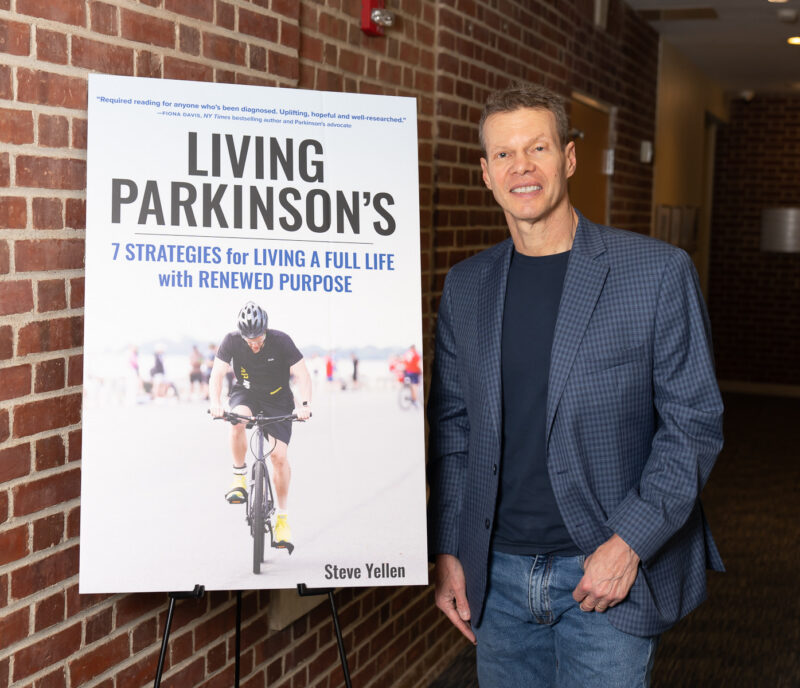
Steve Yellen wrote “Living Parkinson’s” to share the strategies that have helped him in the hope they’ll also benefit others. (Courtesy of Steve Yellen)
What started as a personal effort to manage my diagnosis grew into something bigger: a desire to help others navigate their own journeys — a redefined sense of purpose. Over time, I organized what I had learned into a framework built around seven strategies: attitude, education, support, exercise, wellness, advocacy, and research participation. Each plays a different role in helping people stay engaged with both their health and their lives.
I eventually shared those ideas in a book called “Living Parkinson’s: 7 Strategies for Living a Full Life with Renewed Purpose,” but my goal was simple: to make the framework accessible to anyone who might find it helpful.
Parkinson’s affects everyone differently, and no two journeys look the same. Some people may run races. Others may focus on walking regularly, maintaining independence, or participating in research. What matters most is staying engaged — taking an active role in shaping your path rather than feeling defined by the diagnosis.
Parkinson’s has certainly changed my life. But it’s also given me something unexpected: a renewed sense of direction. What began as an effort to solve a problem for myself has grown into a purpose of helping others face the same challenge with greater confidence. And if sharing this perspective helps even one person take a more active role in their journey, then that purpose is well worth it.
To submit your own Guest Voice for publication on Parkinson’s News Today, please email your idea to our columns manager at [email protected] with the following included in the subject line: “Guest Voice: Parkinson’s News Today.”
Note: Parkinson’s News Today is strictly a news and information website about the disease. It does not provide medical advice, diagnosis, or treatment. This content is not intended to be a substitute for professional medical advice, diagnosis, or treatment. Always seek the advice of your physician or another qualified health provider with any questions you may have regarding a medical condition. Never disregard professional medical advice or delay in seeking it because of something you have read on this website. The opinions expressed in this column are not those of Parkinson’s News Today or its parent company, Bionews, and are intended to spark discussion about issues pertaining to Parkinson’s disease.



Leave a comment
Fill in the required fields to post. Your email address will not be published.