
My dad’s Parkinson’s diagnosis was the beginning of a new chapter
Even as the disease progressed, his personality remained intact
Written by |

When my dad, Jack, was diagnosed with Parkinson’s disease in 2013, the lens of his life dramatically shifted within minutes. While still in a fog, my parents needed to know what they were up against and create a plan.
Most people associate dopamine with pleasure, but this powerful neurotransmitter is so much more. It is like a UPS driver for our brains, delivering precious cargo with crucial messages that affect everything from walking to thinking. Parkinson’s disease results in the slow loss of these vital “drivers.” When Dad’s primary care physician noticed a subtle change in his walking gait, one chapter closed, and another began.
Understanding the disease was the first step; building a strategy was the second. My parents chose a Parkinson’s specialist recommended by my cousin, an experienced neurologist. Joining a local Parkinson’s support group and a clinical trial helped them learn more about the condition. A physical therapist evaluated the house and gave specific safety tips for each room, such as removing throw rugs.

Carbidopa-levodopa was the gold standard treatment. Medication timing needed to be precise, so we taped a schedule to the refrigerator and set smartphone alarms to ensure the timely delivery of those vital dopamine drivers.
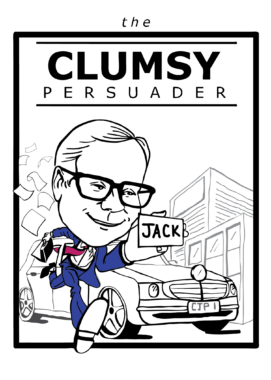
Susan Paolin’s dad, Jack, wrote a memoir called “The Clumsy Persuader” after his Parkinson’s diagnosis. (Illustration by Susan Paolin)
As a lifelong weightlifter, Dad continued to exercise. Movement is critical for Parkinson’s patients, but so is intellectual stimulation. Early in the disease, he channeled his mental energy into writing a memoir, “The Clumsy Persuader,” a witty account of his “Mad Men”-era success and how he navigated obstacles with humor. Writing the book gave him a creative outlet and the power to shape his own legacy.
Cognitively, I saw my dad age in reverse as the disease progressed. Surprisingly, he maintained his core personality with optimism and a great sense of humor.
Once, I remember Dad waking up from a hallucination, asking to get a drink of chocolate milk from a bar that wasn’t there. “Do you see Jackie Gleason behind the bar in the corner of the room?” he asked.
“Jackie Gleason! No, I don’t see him. You’re dreaming!” I said. We both laughed. “Your dream switch must have gotten stuck!”
He asked, “When is somebody going to fix it?”
“I’ll schedule an appointment,” I replied. The faulty dream switch conversation was on a rinse-and-repeat cycle. His short-term memory was affected, but thankfully, his long-term memory was intact.
The enduring human spirit
As the years progressed, so did his symptoms; understanding the practical steps to navigate each stage was important.
But more profound was watching my dad’s internal world continually adapting, finding new ways to adjust to his changing circumstances as well as enjoying things that made him happy, such as making his own anniversary card, watching an Eagles game with my brother, listening to my sister play piano, or simply visiting with the family.
They say musical memory is the last thing to go. My dad loved Johnny Cash, Eddy Arnold, and Hank Williams. When Ken Burns’ “Country Music” documentary aired on PBS, I recorded every episode.
It was like a time warp, transporting him to an earlier decade. As a boy, he played guitar, especially the country and western songs of his era. Although the disease had fully progressed, it was amazing how much he remembered. Many of his favorite artists performed the song “Will the Circle Be Unbroken.” One day, Dad said, “I want ‘Will the Circle Be Unbroken’ played at my funeral.”
My mom said, “Jack, that is not appropriate. It was meant for a matriarch.”
He snapped back, “I don’t care!” That is what he wanted, and that is what he got.
Even as the disease took more, stripping away his physical abilities and eventually confining him to bed, his will did not waver. He still wanted to maintain an exercise routine and lifted dumbbell weights in bed. The hospice care team was surprised at his strength, calling him “strong as a bull.”
Having a very close view of the disease, I know I didn’t have my father’s mental strength. Some days pushed me right to the edge and practically broke me, yet my dad was still fighting. He experienced grief, sadness, and despair, but more often than not, he met life’s most difficult moments with humor, drive, and determination.
Stephen Covey popularizes a famous concept in his book “The 7 Habits of Highly Effective People.” While the origin of the quote is unknown, it’s often attributed to Viktor Frankl: “Between stimulus and response there is a space. In that space is our power to choose our response. In our response lies our growth and freedom.” As my dad’s caregiver, I learned that while aspects of the disease could be measured and predicted, the human spirit could not. It defies all expectations.
Note: Parkinson’s News Today is strictly a news and information website about the disease. It does not provide medical advice, diagnosis, or treatment. This content is not intended to be a substitute for professional medical advice, diagnosis, or treatment. Always seek the advice of your physician or another qualified health provider with any questions you may have regarding a medical condition. Never disregard professional medical advice or delay in seeking it because of something you have read on this website. The opinions expressed in this column are not those of Parkinson’s News Today or its parent company, Bionews, and are intended to spark discussion about issues pertaining to Parkinson’s disease.




Leave a comment
Fill in the required fields to post. Your email address will not be published.