
FDA approves next-gen wearable sensor for tremor control in Parkinson’s
New version of Cala Health device allows more personalized treatment
Written by |
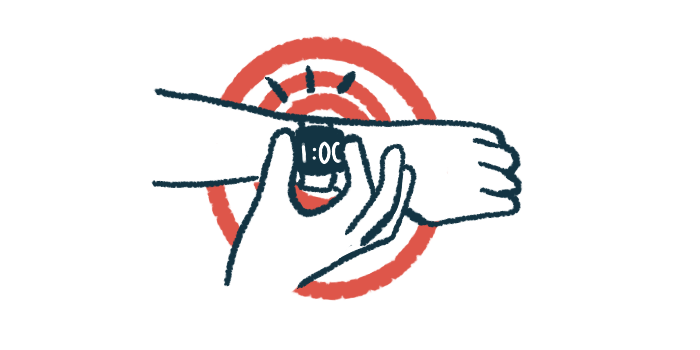
- The FDA has approved Cala kIQ Plus, a wearable neurostimulation device for easing Parkinson's hand tremors.
- Cala Health's noninvasive system uses its TAPS technology for personalized tremor control.
- Worn like a wristwatch, the wearable sensor device is the next-generation version of Cala kIQ.
The U.S. Food and Drug Administration (FDA) has given a green light to the new Cala kIQ Plus system, Cala Health’s next-generation wearable neurostimulation device for helping control hand tremor during movement in people with Parkinson’s disease.
The system is an update of the earlier approved Cala kIQ system, a device worn like a wristwatch that delivers electrical stimulation to nerves in the arm to stimulate brain regions. Both devices use Cala’s TAPS technology — fully, Transcutaneous Afferent Patterned Stimulation.
The new system introduces additional therapy modes and adaptive calibration that the developer says will help to optimize tremor control and personalize treatment.
Cala will present clinical data showing Cala kIQ Plus has improved effectiveness during the American Academy of Neurology annual meeting, taking place April 18-22 in Chicago and online. The device is also approved for use in essential tremor, another condition that causes hand tremors.
“Cala continues to elevate the patient experience and therapy outcomes by advancing wearable neuromodulation technology that treats action hand tremor in essential tremor and Parkinson’s disease,” Deanna Harshbarger, Cala’s CEO, said in a company press release announcing the FDA’s clearance of the new device for use by patients.
“The Cala kIQ Plus system gives patients more control over how, when, and where TAPS Therapy is delivered for tremor management,” Harshbarger said.

Tremor is one of the most common motor symptoms of Parkinson’s, a condition marked by the progressive loss of nerve cells that produce dopamine, a signaling molecule involved in motor control.
Several medications are available to help manage tremors in people with Parkinson’s, while some patients may also benefit from deep brain stimulation (DBS). DBS is a surgical treatment in which an electrode is implanted in the brain to deliver electrical stimulation to specific brain regions and ease motor symptoms.
Wearable device uses AI to personalize the stimulation given
Cala kIQ works on similar principles to DBS, but uses a noninvasive approach. The device measures the patient’s tremor patterns and uses artificial intelligence to personalize the delivered stimulation. It also records data that patients can access and share with their healthcare team via an online portal.
In the poster presentation, titled “Optimizing Transcutaneous Afferent Patterned Stimulation Therapy: Comparison of Variable Waveforms Reveals Increased Responder Rates and Bilateral Tremor Improvement in Essential Tremor,” the company will share data on the performance of three variations of TAPS tested in people with essential tremor.
“TAPS therapy produced … tremor improvement [an easing of symptoms] as measured by TETRAS,” the poster’s conclusions section notes. TETRAS is the Tremor Research Group Essential Tremor Rating Assessment Scale.
Further, use of one of the device variations “significantly increased the proportion of patients achieving clinician-rated functional benefit,” the poster states.
Overall, the results to be presented at the meeting report data from several studies enrolling 78 patients with functionally limiting arm and hand tremors. These participants received standard, burst-frequency variation (BFV), and pulse-frequency variation (PFV) modes for six weeks (two weeks each). Pulse frequency variation refers to varying the timing between individual electrical pulses. Burst frequency variation refers to delivering pulses in rapid groups, then varying the timing between those groups.
An analysis demonstrated that all three TAPS modes significantly reduced tremors. Among 28 patients who completed the study, BFV significantly increased the proportion of patients achieving a functional benefit, compared with standard mode (89.3% vs. 80.4%). Functional benefit was defined as at least a 1-point improvement on the clinician-rated TETRAS.
The researchers noted that the tremor effect was bilateral, indicating functional improvement in both the stimulated and nonstimulated arms. The mean TETRAS change was similar across the three modes.

Cala system available to US veterans at no cost
The Cala system is available through the Veterans Affairs Health System at no cost to eligible beneficiaries and is covered by Medicare for those who meet local coverage criteria, according to the developer.
The company is advocating for additional coverage and reimbursement in Medicare Advantage and commercial payor plans.

Richard
My tremors are serious enough too make writing and many other activities very difficult or impossible. . This device is certainly worth a try. Anyone know how to get ahold of Cala company ? Is it even available? Thanks
Paul Chellakumar
My wife is PD patient
Gina Delta
Is this available in Australia
Abid Ghafoor
I am of 74 age suffering from Parkinson disease since last 5 years .i am more disturbing with stiffness and rigidity very low tremors. Please guide me this Wrist wearing device would help me. How can I get it.
Thnx n Rgds
William Adams
I have Parkinson disease and my hand tremor is increasing. Would like to find out more information about your wrist worn sensor. Thank you