
Study ties gut bacteria to dopamine, Parkinson’s motor control
Experiments show vitamin B6-producing bacteria may help cells make dopamine
Written by |
- Gut bacteria producing vitamin B6 influence dopamine levels and motor control in Parkinson's disease.
- Reduced bacterial vitamin B6 production worsens motor function and increases toxic protein clumps.
- Supplementing vitamin B6 restored motor control in worms and mice.
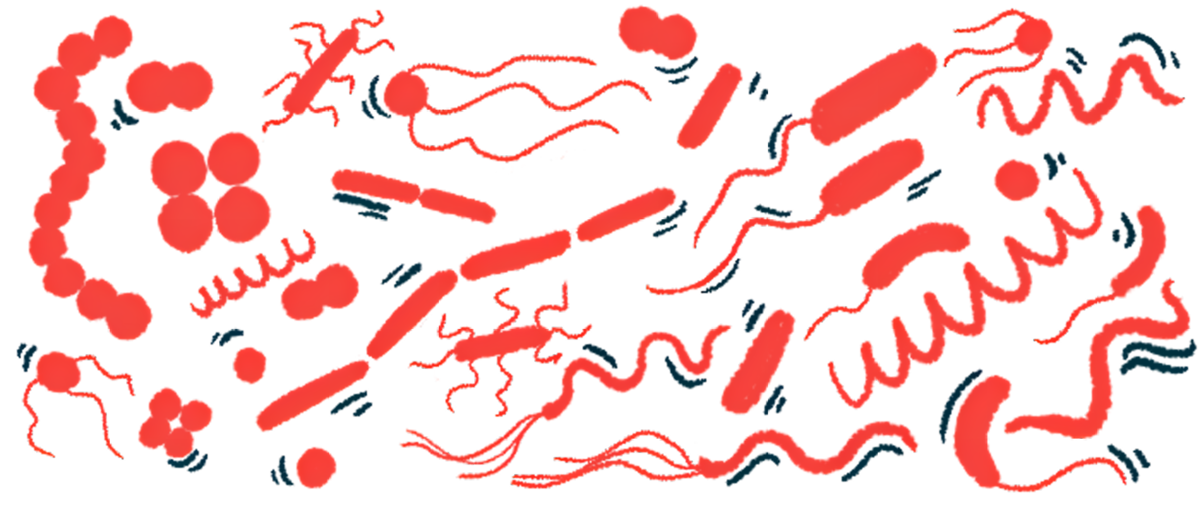
Gut bacteria that produce vitamin B6 may help nerve cells in the brain produce dopamine, a chemical involved in motor control that is missing in Parkinson’s disease, according to an animal study. The research in worms and mice adds to a growing understanding of how the gut-brain axis is involved in the disease’s development and progression.
Giving vitamin B6 to mice that lacked enough of it restored their motor coordination, suggesting that production of vitamin B6 in the gut could be a “context-dependent therapeutic target,” the researchers wrote.
The study, “Vitamin B6 produced by gut microbiome regulates host behavioral phenotypes through dopaminergic metabolism,” was published in Gut Microbes.
Growing evidence suggests that a healthy gut may restore a well-functioning gut–brain axis, a two-way route between the gut and the brain, easing Parkinson’s symptoms. Some vitamins that can be both sourced from food and produced in the gut are essential for maintaining healthy nerve cells. However, the researchers said, “whether and how” gut bacteria are involved is unclear.
Their study focused on vitamin B6, which gut bacteria can produce, and its active form, pyridoxal-5′-phosphate (PLP). PLP is important because it acts as an essential fuel that helps convert levodopa, a mainstay of Parkinson’s treatment, into dopamine in peripheral tissues. This can reduce the amount of levodopa that reaches the brain, making treatment less effective.

Probing a link
To determine whether this hijacking occurs in real life, the researchers compared data from stool samples from people with Parkinson’s and healthy people. They found that patients had significantly more bacterial genes involved in producing both the PLP fuel and tyrosine decarboxylase, the bacterial enzyme that uses that fuel to destroy levodopa before it can leave the digestive tract.
Although these findings suggest that PLP may interfere with levodopa, the researchers wanted to know whether vitamin B6 from gut bacteria also affects the disease itself. To answer this, they conducted experiments in worms and mice to examine the effects of vitamin B6 on dopamine production.
The team first used Caenorhabditis elegans worms, a commonly used model for studying the nervous system. They fed the worms different strains of Escherichia coli, a species of bacteria found in the gut. Some bacterial strains naturally produced less PLP than others. Worms eating these bacteria showed poorer dopamine-dependent movement. Giving the worms pyridoxal (PL), a form of vitamin B6 that the body can convert into PLP, restored normal movement.
The researchers also reduced the amount of PLP the worms could produce on their own by deleting the pdxK gene, which is needed to convert PL into PLP. These worms had lower levels of PLP and dopamine and moved poorly. However, adding PL increased both dopamine and movement, showing that vitamin B6 produced by bacteria can help when the host cannot produce enough PLP.
PLP is required by dopa decarboxylase (DDC), the enzyme humans use to convert levodopa into dopamine. In worms that could not produce enough levodopa, adding PL or levodopa increased dopamine. However, when DDC was less active, these treatments were much less effective, suggesting that bacterial vitamin B6 helps produce dopamine by supporting the host’s own dopamine-producing enzyme.
Bacteria lacking pdxJ, a gene of the main pathway that produces vitamin B6, produced lower levels of PLP as well as lower levels of other forms of vitamin B6, which are important because, unlike PLP, they can easily enter the brain and later be converted into PLP. When worms were fed bacteria lacking pdxJ, they, too, had lower levels of PLP and dopamine. Giving these worms PL restored both vitamin B6 and normal movement.
In a worm model of Parkinson’s that produces human alpha-synuclein, a protein that forms toxic clumps in the brains of people with the disease, worms fed bacteria without pdxJ developed more toxic clumps. Another model carried a mutation in the human LRRK2 gene, one of the most common genetic causes of Parkinson’s. These worms also had motor problems when fed bacteria lacking pdxJ.
Mice colonized with bacteria lacking pdxJ had lower blood vitamin B6 levels. Their brains also contained less PLP. The greatest effect occurred in the substantia nigra, the region where dopamine-producing nerve cells are lost in Parkinson’s. These mice had lower levels of tyrosine hydroxylase, the enzyme that initiates dopamine production. The changes were not caused by inflammation.
The mice also developed poorer balance and coordination during a six-week movement test. Giving them PL restored vitamin B6 and eased motor problems. Overall, the study identified a molecular pathway centered on the pdxJ gene that controls vitamin B6 production. These findings suggest that bacterial production of vitamin B6 is a possible risk factor and a potential target for future treatments.
“The dual nature of bacterial PLP, protective under physiological conditions yet antagonistic [with an effect that counteracts treatment with levodopa], emphasizes the importance of microbial metabolism in shaping both Parkinson’s onset and treatment response,” the researchers wrote.



Lucinda A. Bedwell
I believe that the fact that I have had 3 E. Coli infections since 2014, none which were connected with anything I ate, contributed to my Parkinson's. I also had 2 severe cases of gastroenteritis back to back at the age of 12. In 1997, I had an appendectomy 18 and a half hours after my appendix had ruptured which also may have played a part in developing Parkinson's Disease.
Becky Andrews
Would like more information