Juvmo (tavapadon) for Parkinson’s disease
 Fact-checked by
What is Juvmo for Parkinson’s disease?
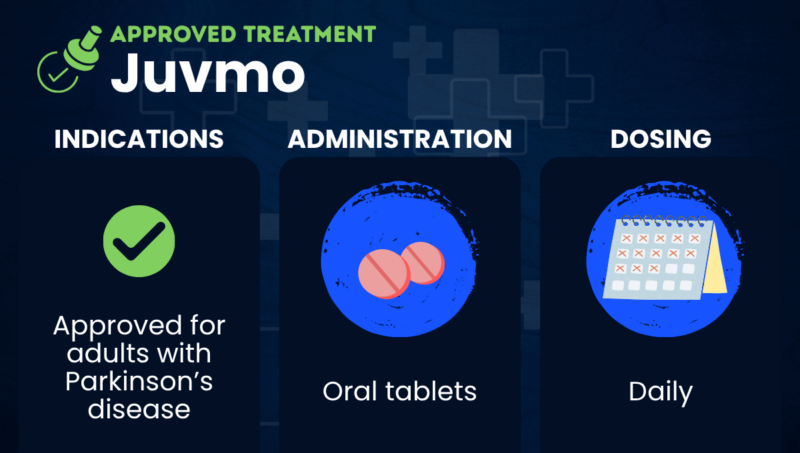
Juvmo (tavapadon) is an approved oral therapy from Abbvie that is used to treat adults with Parkinson’s disease.
In people with early Parkinson’s, it may be used alone to help control motor symptoms. In people with more advanced Parkinson’s who are already using levodopa, Juvmo can be added on to reduce off time, or daily periods when the effects of levodopa wear off and motor symptoms fluctuate.
The symptoms of Parkinson’s disease are largely driven by the loss of nerve cells that produce a brain signaling molecule called dopamine.
Juvmo belongs to a class of Parkinson’s treatments called dopamine agonists, meaning it mimics dopamine by binding to and activating the receptor proteins through which dopamine normally exerts its effects. This is expected to help compensate for the loss of dopamine in Parkinson’s, easing motor symptoms and controlling off episodes.
The medication differs from other dopamine agonists because it specifically targets the dopamine receptors that control movement, while avoiding activation of receptors involved in dopamine’s other functions. This could help reduce some of the side effects that are traditionally linked to older dopamine agonists.
Therapy snapshot
| Brand name | Juvmo |
| Chemical name | Tavapadon |
| Usage | Used to treat adults with Parkinson’s disease |
| Administration | Oral tablets |
Who can take Juvmo?
In the U.S., Juvmo is approved for the treatment of Parkinson’s disease in adults.
There are no contraindications, or reasons not to use the medication.
How is Juvmo administered?
Juvmo comes in the form of oral tablets to be taken once daily, with or without food. It is initiated at a very low dose (0.25 mg daily) and slowly titrated up to its recommended daily maintenance dose of 5 mg over the course of 40 days using a titration pack.
Once the maintenance dose is reached, it can be gradually increased to 15 mg daily, if recommended by a doctor, based on clinical need and tolerability.
Dose modifications may be needed for people taking certain medications that affect the activity of CYP3A, the enzyme responsible for breaking down Juvmo in the body.
Juvmo in clinical trials
Juvmo’s approval was supported by data from three placebo-controlled Phase 3 clinical trials involving adults with Parkinson’s disease. In each, participants received either Juvmo or a placebo for 27 weeks, or about six months.
In two of these studies, participants had early-stage Parkinson’s and were not using levodopa. These studies assessed changes in Movement Disorder Society-Unified Parkinson’s Disease Rating Scale (MDS-UPDRS) Part II and III scores, which evaluate how motor symptoms affect daily life and motor symptom severity, respectively.
- In TEMPO-1 (NCT04201093), fixed daily doses of Juvmo (5 mg or 15 mg) were associated with significant improvements in MDS-UPDRS II scores and combined MDS-UPDRS II and III scores relative to the placebo after 26 weeks.
- In TEMPO-2 (NCT04223193), individualized daily doses of Juvmo (5 mg to 15 mg) were likewise associated with significant improvements in MDS-UPDRS II and combined MDS-UPDRS III scores relative to the placebo.
The third study, TEMPO-3 (NCT04542499), involved patients experiencing off-time on oral levodopa therapy. Juvmo or a placebo was added to levodopa. The results showed that:
- daily on-time without troublesome dyskinesia — time when motor symptoms are adequately controlled without the involuntary movements (dyskinesia) that can be a side effect of levodopa treatment — was significantly increased by more than an hour with Juvmo relative to the placebo
- total daily off time was correspondingly significantly decreased by about an hour with Juvmo relative to the placebo
Participants in any of these trials could subsequently participate in a long-term extension study called TEMPO-4 (NCT04760769). Data showed that Juvmo’s efficacy was sustained for more than 1.5 years. Among those using levodopa, 93% did not need to increase their dose. Of those not using levodopa, 94% did not need to initiate it.
Juvmo side effects
The most common side effects when Juvmo is not used alongside levodopa include:
- nausea
- headache
- dizziness
- fatigue
- altered sense of taste
- vomiting
- dry mouth
- anxiety
The most common side effects when Juvmo is used alongside levodopa include:
- nausea
- new or worsening dyskinesia
- dizziness
- headache
- hallucinations
- orthostatic hypotension, a drop in blood pressure when standing up
Juvmo also carries warnings for other less common, but potentially serious side effects, including:
- abnormal thoughts and behaviors, including paranoia, delusions, hallucinations, confusion, psychotic-like behavior, aggression, agitation, or delirium
- impulse control problems or compulsive behaviors, such as urges to gamble, sexual urges, uncontrolled spending, or binge eating
If these occur, a doctor may recommend lowering the dose of Juvmo or discontinuing treatment.
Juvmo might interact with a number of other substances. It may be advised that Juvmo be avoided alongside certain medications or that the dosing regimens be adjusted. Individuals should always inform their care providers about all medications they are using.
Parkinson's News Today is strictly a news and information website about the disease. It does not provide medical advice, diagnosis, or treatment. This content is not intended to be a substitute for professional medical advice, diagnosis, or treatment. Always seek the advice of your physician or other qualified health provider with any questions you may have regarding a medical condition. Never disregard professional medical advice or delay in seeking it because of something you have read on this website.