Skip to content
Parkinson's News Today logo Newsletter
Newsletter
  • About Parkinson's
    What is Parkinson’s disease?
    Causes
    Diagnosis
    Symptoms
    • Motor symptoms
    • Non-motor symptoms
    Types
    Treatments
    • Approved treatments
    • Experimental treatments
    • Non-drug treatments
  • Living with Parkinson’s
    Living with Parkinson’s
    • Videos: Shifting gears
    • Staying socially engaged
    • Parkinson’s management
    • Exercise and mobility tips
    • Caregiving and Parkinson’s
    • Exercise motivation
    • Nutrition and Parkinson’s
    • Parkinson’s progression
    • Cognitive health tips
    • Foot health and safety
    • View all
    Caregivers of spouses
    • Early signs of psychosis
    • Preparing for psychosis
    • Perspective: Supporting your spouse
    • Respite care
    • Hallucinations, delusions, illusions
    Caregivers of parents
    • Talking to a parent with psychosis
    • Psychosis care options
    • Perspective: Caring for a parent
    • Do’s and don’ts
    • Remote Parkinson’s care
    Patients
    • What is psychosis?
    • Talking to your doctor about psychosis
    • Perspective: Living with psychosis
    • Emotional and mental health
    • Psychosis risk factors
    In focus video series
    • Managing Parkinson’s psychosis
    • Strategies for managing psychosis
    • Early signs of psychosis
    • Discerning Parkinson's-related psychosis
    Parkinson's psychosis guide
  • News
  • Community
    Columns
    • The Bright Side – Jamie Askari
    • The Impatient Patient – Doc Irish
    • Living My Best Life – Christine Scheer
    • Shaking Things Up — Mary Beth Skylis
    • Unshakable Optimist – Mollie Lombardi
    Archived columns
    • The Love Factor – Chukwuemeka Uchebuakor
    • PD: The WE Journey – Jill Hammergren
    • Embrace the Shake — Samantha Felder
    • Life, Lemons, and Lemonade — Lori DePorter
    • Possibilities With Parkinson’s — Dr. C
    • Resilient: Living Relentlessly — Jo Gambosi
  • Forums
  • Resources
    Advocacy partners
  • What can we help you find today?

Anavex 2-73 (blarcamesine) for Parkinson’s disease

Last updated Sept. 10, 2025, by Andrea Lobo, PhD
✅ Fact-checked by Ana de Barros, PhD

Administration
Clinical trials
Side effects


What is Anavex 2-73 for Parkinson’s disease?

Anavex 2-73, also known as blarcamesine, is an experimental oral treatment that Anavex Life Sciences is developing to treat Parkinson’s disease dementia and other neurological conditions.

Parkinson’s disease is caused by the dysfunction and progressive death of dopaminergic neurons, the nerve cells in the brain responsible for producing dopamine, a signaling molecule essential for motor control.

The loss of these neurons disrupts dopamine signaling, leading to the disease’s hallmark motor symptoms, such as tremors, muscle rigidity, or slowness of movement.

Beyond motor impairment, many patients also experience nonmotor symptoms, including sleep disturbances, mood disorders, and cognitive decline. In later stages, cognitive issues can progress to Parkinson’s disease dementia, a condition marked by significant impairments in memory, attention, and in problem-solving and visuospatial abilities, which profoundly affect quality of life and independence.

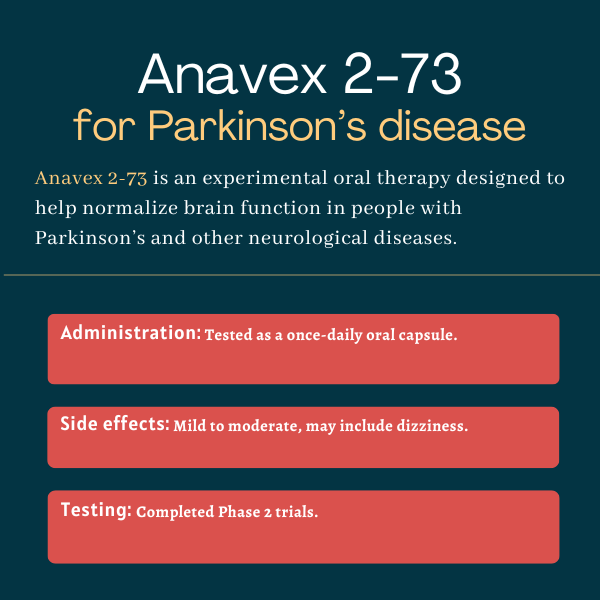
Anavex 2-73 is an oral small-molecule activator of a brain protein called sigma-1 receptor (SIGMAR1), which is reduced in people with Parkinson’s and other neurological conditions. The treatment, intended to be taken as an oral capsule once daily, is designed to help restore nerve cell health by reducing abnormal protein folding, reducing inflammation, and improving the function of mitochondria, the cells’ powerhouses.

While Anavex 2-7 is being developed for people with Parkinson’s disease dementia, the company also intends to explore its potential in those with Parkinson’s disease without dementia.

Therapy snapshot

Treatment name: Anavex 2-73
Administration: Oral capsules
Clinical testing: Completed Phase 2 trial in people with Parkinson’s disease dementia


How will Anavex 2-73 be administered?

In clinical trials testing Anavex 2-73 in people with Parkinson’s disease, the treatment was administered as oral capsules at two dose levels — 30 or 50 mg — taken once daily.
Anavex 2-73 in clinical trials

The safety, tolerability, and efficacy of Anavex 2-73 were investigated in a Phase 2 trial (NCT03774459) involving 132 people with Parkinson’s disease dementia. The trial tested the therapy against a placebo for 14 weeks, or about 3.5 months, after which patients could enroll in an open-label extension where all received the treatment.

Compared to a placebo, Anavex 2-73 led to clinically meaningful improvements in cognitive skills and reduced REM sleep behavior disorder, a condition characterized by physically acting out dreams, which is associated with greater cognitive impairment and a higher risk of dementia.

Benefits were also observed in a reduction of motor symptoms and were tied to a rise in SIGMAR1 levels.

Results from the open-label extension (NCT04575259) study, where all the participants received the treatment for up to a year, demonstrated similar treatment benefits to those in the original Phase 2 study. Anavex 2-73 was also found to be generally safe and tolerated well.

Anavex 2-73 side effects

Safety findings in people with Parkinson’s who participated in the Phase 2 trial were consistent with the known safety profile of Anavex 2-73 observed in trials for other neurological conditions. Reported side effects were mild or moderate in severity and mainly included dizziness. No serious side effects have been observed so far.


Parkinson’s News Today is strictly a news and information website about the disease. It does not provide medical advice, diagnosis, or treatment. This content is not intended to be a substitute for professional medical advice, diagnosis, or treatment. Always seek the advice of your physician or other qualified health provider with any questions you may have regarding a medical condition. Never disregard professional medical advice or delay in seeking it because of something you have read on this website.

Recent Posts

  • The unexpected gifts that Parkinson’s has prompted
  • Solengepras significantly reduces off time for patients on levodopa
  • Brain ‘short circuit’ behind Parkinson’s motor issues: Study
  • Parkinson’s disrupts key brain connections, PET scan study finds
  • Finding ways to make Parkinson’s hospital care more ‘age friendly’


Related articles

  1. banner image for the column
    December 12, 2025 Columns by Christine Scheer

    The unexpected gifts that Parkinson’s has prompted

  2. A speaker gives a presentation to a large audience at a conference, using a white board to show data.
    December 12, 2025 News by Andrea Lobo

    Solengepras significantly reduces off time for patients on levodopa

  3. Lightning bolts are pictured shooting out from an image of the human brain.
    December 11, 2025 News by Andrea Lobo

    Brain ‘short circuit’ behind Parkinson’s motor issues: Study

  4. An illustration shows a human brain.
    December 10, 2025 News by Andrea Lobo

    Parkinson’s disrupts key brain connections, PET scan study finds

  5. A clinician chats with an older man sitting in a chair.
    December 9, 2025 News by Andrea Lobo

    Finding ways to make Parkinson’s hospital care more ‘age friendly’

  6. Column banner for Unshakable Optimist by Mollie Lombardi
    December 8, 2025 Columns by Mollie Lombardi

    Don’t wait for a health crisis to practice self-care

Swipe left to view more
Envelope icon

Subscribe to our newsletter

Get regular updates to your inbox.

This field is for validation purposes and should be left unchanged.

Bionews, Inc.

3 W Garden St
Suite 700
Pensacola, FL 32502
Website: bionews.com
Email: [email protected]
Phone: 1-800-936-1363

  • About Us
  • Leadership
  • Our Culture
  • Editorial Policy
  • Advertising Policy
  • Corrections Policy
  • Terms of Service
  • Privacy Policy
  • Careers
  • Contact Us
Disclaimer

This site is strictly a news and information website about the disease. It does not provide medical advice, diagnosis or treatment. This content is not intended to be a substitute for professional medical advice, diagnosis, or treatment. Always seek the advice of your physician or other qualified health provider with any questions you may have regarding a medical condition. Never disregard professional medical advice or delay in seeking it because of something you have read on this website.

Copyright © 2013-2025 All rights reserved.