Zelapar (selegiline hydrochloride) for Parkinson’s disease
 Fact-checked by
 What is Zelapar for Parkinson’s disease?
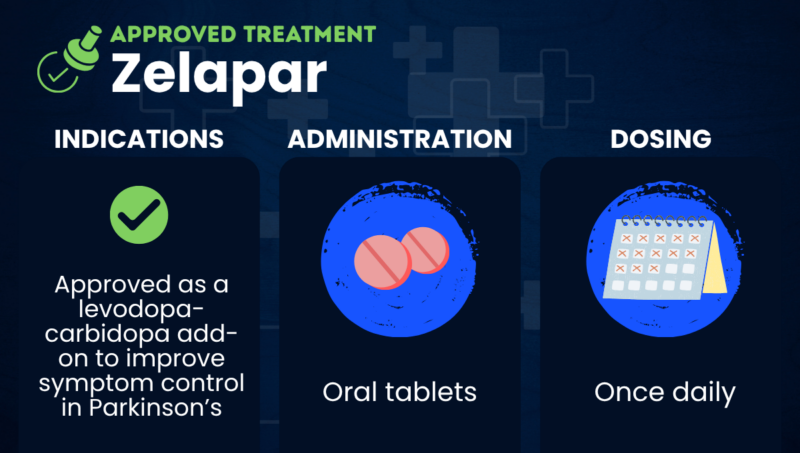
Zelapar (selegiline hydrochloride) is an oral add-on therapy approved for people with Parkinson’s disease who are already receiving levodopa and carbidopa. The medication, available in the form of orally disintegrating tablets, is used for Parkinson’s patients whose symptoms are not well controlled with their levodopa/carbidopa treatment.
A progressive condition, Parkinson’s develops when nerve cells in the brain that produce dopamine, a chemical messenger that helps control movement, gradually become damaged and die. As dopamine levels decline, symptoms such as tremor, stiffness, slowed movement, and balance problems develop.
People with Parkinson’s are normally treated with levodopa and carbidopa to supply the brain with dopamine precursors. However, the treatment’s effects may wear off between doses, leading to off episodes or motor fluctuations that can worsen as the disease progresses.
Zelapar belongs to a class of medications called monoamine oxidase type B (MAO-B) inhibitors. MAO-B is an enzyme that breaks down dopamine. By blocking this enzyme, Zelapar allows dopamine to remain available in the brain for longer, helping reduce off episodes and improve symptom control.
The brand-name medication is sold by Bausch Health, but several generic versions of selegiline disintegrating tablets are also available in the U.S.
Therapy snapshot
| Brand name | Zelapar |
| Chemical name | Selegiline hydrochloride |
| Usage | Used to improve symptom control in people with Parkinson’s already taking levodopa and carbidopa |
| Administration | Orally disintegrating tablets |
Who can take Zelapar?
Zelapar is approved in the U.S. as an add-on treatment for people with Parkinson’s who are being treated with levodopa and carbidopa but are experiencing a decline in the quality of their response to their prescribed medication.
Because of the risk of drug interactions, Zelapar is contraindicated, meaning it should not be used, with any of the following medications and supplements:
- opioid medications
- other monoamine oxidase (MAO) inhibitors
- St. John’s wort, an herbal supplement used for depression and certain other conditions
- cyclobenzaprine, a muscle relaxant
- the anti-cough medicine dextromethorphan
Zelapar also is not recommended for people with severe liver or kidney impairment. Patients with major psychotic disorders also generally should not be treated with Zelapar because the drug may worsen psychosis.
There is no evidence that Zelapar has any beneficial effect if not taken alongside levodopa therapy.
How is Zelapar administered?
Zelapar is available as orally disintegrating tablets that dissolve on the tongue.
The recommended starting dosage is 1.25 mg once daily for at least six weeks. If additional symptom control is needed and the medication is well tolerated, the dose may be increased to 2.5 mg once daily. Higher doses are not recommended because they have not been shown to provide additional benefit and may increase the risk of side effects. Individuals with mild to moderate liver impairment may require dose adjustments.
The medication is taken once daily before breakfast. Patients should place the tablet on the tongue and allow it to dissolve without water, and should avoid eating or drinking for five minutes before and after taking a dose.
Those wishing to discontinue or decrease the dose of Zelapar should contact their healthcare provider, as abruptly reducing or stopping the medication can result in high fever, muscle stiffness, and changes in consciousness.
Zelapar in clinical trials
Zelapar’s approval was mainly supported by data from a clinical trial involving 140 people with Parkinson’s disease who were receiving levodopa and experiencing at least three hours of daily off time. Participants were randomly assigned to receive either Zelapar or a placebo over three months. The results showed that:
- Zelapar reduced daily off time by about 2.2 hours, compared with 0.6 hours with a placebo
- Zelapar increased daily on time without troublesome dyskinesia by 1.8 hours
In Parkinson’s, on time periods are when the medication is actively working, and patients are not experiencing excessive, involuntary movements, known as dyskinesia, that can happen as a treatment side effect.
Potential side effects of Zelapar
The most common side effects of Zelapar are:
- constipation
- skin disorders or rash
- vomiting
- dizziness
- dyskinesia
- insomnia
- shortness of breath
- muscle pain
The medication’s prescribing information has warnings about other potentially serious side effects with its use, such as:
- high blood pressure, particularly after consuming foods very high in tyramine or taking medications that affect blood pressure
- serotonin syndrome, a potentially life-threatening drug reaction caused by excess serotonin in the body, which may occur if Zelapar is taken alongside certain medications
- excessive sleepiness or suddenly falling asleep during daily activities
- low blood pressure upon standing
- new or worsening dyskinesia
- hallucinations or psychotic behaviors
- impulse control issues (e.g., gambling, binge eating)
- irritation, ulcers, or swelling inside the mouth
Because Zelapar contains the protein building block phenylalanine, it can also be harmful to patients with phenylketonuria, a rare disorder that causes phenylalanine to build up in the body.
Parkinson's News Today is strictly a news and information website about the disease. It does not provide medical advice, diagnosis, or treatment. This content is not intended to be a substitute for professional medical advice, diagnosis, or treatment. Always seek the advice of your physician or other qualified health provider with any questions you may have regarding a medical condition. Never disregard professional medical advice or delay in seeking it because of something you have read on this website.