Rytary (carbidopa and levodopa) for Parkinson’s disease
 Fact-checked by
 What is Rytary for Parkinson’s disease?
Rytary (carbidopa and levodopa) for Parkinson’s disease is an approved extended-release oral combination therapy used to manage disease symptoms. It may help reduce the amount of time spent in off episodes — periods of fluctuating motor symptoms in between doses — relative to standard immediate-release formulations of carbidopa and levodopa.
The progressive degeneration of nerve cells that produce the chemical signaling molecule dopamine causes Parkinson’s. As dopamine levels in the brain fall, a variety of crucial brain functions are disrupted, leading to motor and nonmotor symptoms.
Levodopa and carbidopa are a standard Parkinson’s treatment combination. Levodopa is a precursor molecule that the body can convert into dopamine to replenish levels of the missing chemical. Carbidopa helps maximize levodopa’s efficacy by preventing its conversion to dopamine before it reaches the brain.
Rytary comes as capsules that contain both fast-acting and slower-acting beads of medication. This means that Rytary can begin to work quickly, while also potentially having more stable and sustained effects than other formulations of levodopa and carbidopa.
Amneal Pharmaceuticals markets Rytary extended-release capsules in the U.S., where the medication is also approved for the management of Parkinson’s-like symptoms (parkinsonism) that can occur after encephalitis, or inflammation of the brain, or after carbon monoxide or manganese poisoning. Although there is no generic form of Rytary, different formulations of levodopa and carbidopa, including other extended-release formulations, are available.
Therapy snapshot
| Brand name | Rytary |
| Chemical name | Carbidopa and levodopa |
| Usage | Used to ease symptoms of Parkinson’s disease |
| Administration | Extended-release oral capsules |
Who can take Rytary?
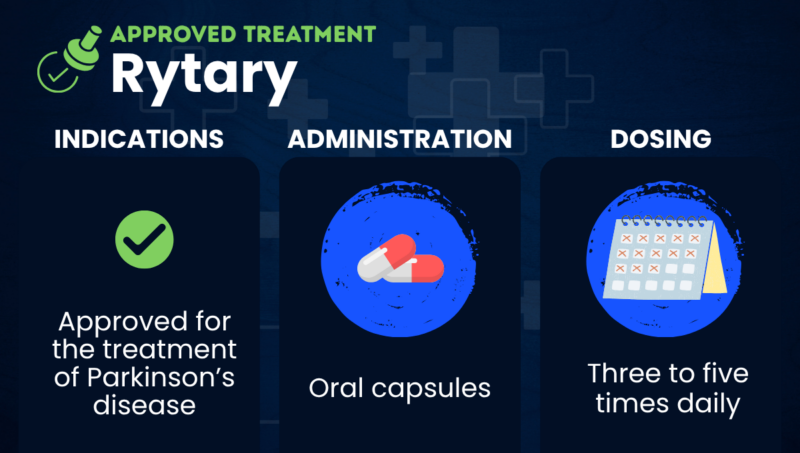
Rytary is approved in the U.S. for the treatment of Parkinson’s disease.
According to Rytary’s prescribing information, the medication is contraindicated, or should not be used, in people who are taking or have taken a nonselective monoamine oxidase (MAO) inhibitor within the previous two weeks, because of the risk of high blood pressure complications.
However, Rytary may be taken with selective MAO-B inhibitors, a type of Parkinson’s therapy, with physician supervision.
Rytary should not be used in people with major psychotic disorders.
How is Rytary administered?
Rytary comes as extended-release capsules that should be swallowed whole, with or without food. The capsules should not be divided, chewed, or crushed. For people with swallowing difficulties, the capsules can be opened and the contents sprinkled on 1-2 tablespoons of applesauce and consumed immediately.
The medication is typically taken three times daily, although it may be used up to five times daily in some people. The specific Rytary dosage depends on the individual, with lower starting doses generally used in people who have not previously taken levodopa.
For those transitioning from immediate-release levodopa/carbidopa formulations, such as Sinemet, a doctor will determine the appropriate starting dose. When converting to Rytary from Sinemet or similar medications, a 1:1 dose conversion cannot be used.
Starting doses of Rytary can be adjusted based on how a person responds to treatment, but the maximum recommended daily total dose is 612.5 mg carbidopa/2,450 mg levodopa.
Rytary in clinical trials
Data from two Phase 3 clinical trials of Rytary supported its approval in the U.S.:
- APEX-PD (NCT00880620) included 381 people with early Parkinson’s who received one of three doses of Rytary or a placebo three times daily for 30 weeks (nearly seven months). All doses of Rytary were associated with significant reductions in motor symptom severity and its impact on daily life compared with the placebo.
- ADVANCE-PD (NCT00974974) included 393 participants with advanced Parkinson’s who were experiencing at least 2.5 hours of daily off time despite ongoing treatment with another levodopa formulation. Participants were all converted to Rytary for six weeks; half subsequently remained on Rytary for 13 more weeks, while half returned to their immediate-release formulation. Rytary significantly reduced daily off time by an average of just over an hour compared with the immediate-release formulation.
The Phase 3 ASCEND-PD trial (NCT01130493) later tested Rytary against immediate-release carbidopa and levodopa plus the COMT inhibitor entacapone. It found that Rytary reduced off time significantly more than the other treatment combination.
Rytary side effects
The most common side effects of Rytary in people with early Parkinson’s disease include:
- nausea
- dizziness
- headache
- insomnia
- abnormal dreams
- dry mouth
- dyskinesia, or uncontrolled, involuntary movements
- anxiety
- constipation
- vomiting
- orthostatic hypotension, or a drop in blood pressure upon standing
The most common Rytary side effects in advanced Parkinson’s disease include nausea and headache.
In some cases, adjusting the dose of Rytary can help manage side effects such as dyskinesia.
There are also several other safety considerations for Rytary, including:
- excessive drowsiness or falling asleep during everyday activities
- new or worsening hallucinations (seeing or hearing things that aren’t there) and psychotic-like behavior
- problems with impulse control or strong compulsions
- reduced vitamin B6 levels, as severe vitamin B6 deficiency can cause seizures
- cardiovascular complications in people with a history of heart disease
- bleeding in the upper gastrointestinal tract for people with a history of peptic ulcers
- increased pressure in the eyes for people with glaucoma
Patients will be monitored for these complications as appropriate. Depending on the complication, a doctor may recommend adjusting the Rytary dose or discontinuing it. Suddenly stopping treatment with Rytary can trigger potentially serious withdrawal symptoms, including high fever and confusion. Treatment should always be tapered under medical supervision.
Parkinson's News Today is strictly a news and information website about the disease. It does not provide medical advice, diagnosis, or treatment. This content is not intended to be a substitute for professional medical advice, diagnosis, or treatment. Always seek the advice of your physician or other qualified health provider with any questions you may have regarding a medical condition. Never disregard professional medical advice or delay in seeking it because of something you have read on this website.