
Genes may determine how coffee affects Parkinson’s risk
Study finds 'complex interplay' depending on genetics, sex
Written by |

- A person's genetic makeup and sex may influence whether coffee consumption increases or decreases their risk of developing Parkinson’s disease.
- Drinking up to four cups of coffee daily reduced Parkinson's risk in carriers of the CYP1A2 AA genotype, particularly women.
- Consuming five or more cups a day increased Parkinson's risk for those with AC or CC genotypes, primarily among men.
A person’s genetic makeup may shape whether coffee consumption raises or lowers the risk of Parkinson’s disease, a study found.
Drinking no more than four cups of coffee a day appeared to reduce the risk of Parkinson’s in people who carry a specific genetic version of the CYP1A2 gene, the AA genotype, particularly for women, the study showed. However, drinking five or more cups may increase the risk of developing the disease in people with the AC or CC genotype, mainly in men.
“These findings underscore the complex interplay between genetics, sex, and coffee,” a group of researchers in China working with data from the U.K. Biobank wrote in the study, “Coffee and Parkinson’s disease: associations by CYP1A2 genotype and sex in UK Biobank,” which was published in npj Parkinson’s Disease.
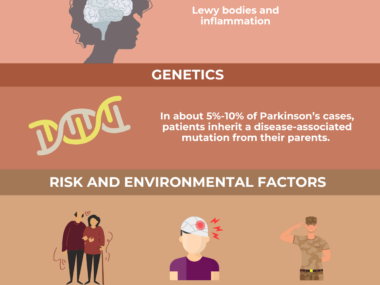
Studies have shown that both genetic and environmental factors play a role in Parkinson’s. Some environmental factors may help protect against the disease and delay symptom onset and worsening. For example, genetic mutations may predispose patients to develop Parkinson’s symptoms at a younger age, while drinking coffee may offset this risk. But results have been inconsistent.

Understanding differences
The researchers sought to understand whether genetic differences might explain why coffee appears protective in some people but not in others. They analyzed data from 435,551 people from the U.K. Biobank, among whom 3,319 were diagnosed with Parkinson’s over a median of 15.7 years.
The team tracked participants’ daily coffee intake alongside their CYP1A2 gene status while controlling for other health and lifestyle factors. The gene encodes an enzyme that helps the liver break down caffeine, the main stimulant in coffee.
More than half of the participants had a version of CYP1A2 called AA (52%); the others carried the AC (40%) or CC (8%) genotype. These different versions of the enzyme can affect how quickly the body processes caffeine. When coffee was not considered, there were no differences in Parkinson’s frequency among the three groups.
However, among people with the AA genotype, drinking fewer than five cups of coffee a day was linked to a 17% lower risk of developing Parkinson’s. The lowest estimated risk occurred at roughly two to three cups of coffee a day. Drinking five or more cups a day was not significantly linked to either higher or lower risk in this group.
The pattern differed between people with the AC or CC genotype. Among people with the AC genotype, drinking five or more cups a day was linked to a 43% higher risk of Parkinson’s. Among those with the CC genotype, the estimated risk was 84% higher. These results suggest that drinking more coffee may be linked to Parkinson’s in people who may process caffeine more slowly.
The researchers also examined men and women separately. Among women with the AA genotype, drinking fewer than five cups a day was linked to a 27% lower risk of Parkinson’s. This association was not observed in men with the AA genotype. In contrast, more coffee was linked to a 53% higher risk among men with the AC genotype. Among those with the CC genotype, the estimated risk was even higher, by 137%.
While the study does not directly prove that coffee causes or prevents Parkinson’s — other factors, such as smoking and alcohol habits, may have influenced the results — it suggests that broad generalizations may mask important differences among groups.
“Our results emphasize the necessity of integrating both genetic and sex-based stratification into epidemiological models to elucidate context-dependent risk–benefit patterns, thereby supporting personalized prevention strategies and guiding future mechanistic research,” the researchers wrote.


Lorne Fisher
How do i find out what my g note code is ???