
Finding solutions for REM sleep behavior disorder with Parkinson’s
We had to make changes for our safety and sanity
Written by |

It was 2:30 a.m., and I was peacefully asleep when I was jolted awake by an arm suddenly flinging over from the other side of the bed, landing squarely on my face. Instantly, shrieks erupted — first from me, then from my husband, Dave, and finally from both of us together. “Stop it, Dave!” I shouted. “You’re having a dream!”
Dave snapped back to reality, immediately apologized, and asked if I was injured. This is his usual response after one of his night terrors, especially when it involves the rare but unforgettable physical outbursts directed at me.
Dave has lived with Parkinson’s disease for 25 years, since he was 49. About a decade after his diagnosis, he began experiencing a new symptom: vivid, active dreaming. He often talks in his sleep, rarely making much sense when I’m awake to overhear him. Most of the time, it’s benign, sometimes even cheerful, and I simply roll over and drift back to sleep. Occasionally, though, he acts out, defending himself against imagined dangers in his dreams. I should stress that these nighttime thrashings and outbursts are not routine. Instead of his usual lighthearted sleep talk, he’ll sometimes cry out in genuine fear. He rarely remembers much about these dreams, so I typically don’t press for details.
‘Somewhere over the rainbow’
Over the years, I’ve been hit on the arm, torso, and head — fortunately, never very hard. The recent episode was the first time he’d struck my face. Thankfully, his fingernail only grazed just below my eye. I got up to check the damage: a bit of broken skin and maybe the start of a bruise. Realizing how close he’d come to my eye, I felt a wave of gratitude that it wasn’t worse — as did he. We knew it was time to find a way to keep us both safe.
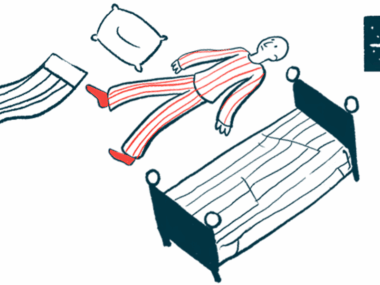
I learned that what Dave experiences is called rapid eye movement (REM) sleep behavior disorder. During the REM stage of sleep, when most dreaming occurs, someone with Parkinson’s can thrash, shout, flail their arms, or even leap from bed. I’ve caught Dave trying to climb out of bed during one of these episodes and calmly told him he was dreaming and to lie down. He complied, still half-asleep, while I, naturally, lay awake for the rest of the night.
Carbidopa and levodopa, two of the standard medications for Parkinson’s, can cause disturbed sleep as a side effect. However, Dave doesn’t take this medication; his deep brain stimulation effectively manages his symptoms without it.
Some prescribed medications target REM sleep behavior disorder, but Dave’s doctor recommended trying over-the-counter melatonin first. We’re happy to report that his nightly 10 mg dose not only helps him fall asleep but also reduces the intensity of his sleep disorder symptoms. If he forgets to take it, the active dreams reliably return. (Everyone is different, so always speak with your doctors before starting or stopping a therapy or supplement.)
Recognizing how these episodes affect both of us, we’ve made practical changes to adapt to this new reality. We upgraded from a queen-size bed to a king-size one to increase the distance between us. We opted for a split king, which consists of two extra-long twin beds pushed together. The small gap between the mattresses means we can’t easily snuggle anymore, which we miss, but the setup keeps us both safer during night terrors. Plus, if needed, we can separate the beds entirely.
These changes have led to sweet dreams for both of us.
Note: Parkinson’s News Today is strictly a news and information website about the disease. It does not provide medical advice, diagnosis, or treatment. This content is not intended to be a substitute for professional medical advice, diagnosis, or treatment. Always seek the advice of your physician or another qualified health provider with any questions you may have regarding a medical condition. Never disregard professional medical advice or delay in seeking it because of something you have read on this website. The opinions expressed in this column are not those of Parkinson’s News Today or its parent company, Bionews, and are intended to spark discussion about issues pertaining to Parkinson’s disease.

Robert cullingworth
How you describe your sleep troubles was identical to the problem my wife and I have thanks for the imformation
Marjorie Weiss
I’m glad it was helpful for you. Best of luck.
Jim butler
Per my sleep doc I started with 10mg, then 12, then 15 mg of melatonin. Kept the acting out dreams at bay for several years. Now in addition to 15 mg melatonin I take .25 mg of clonazepam. No more bad dreams. No side effects. I’m relieved….
Marjorie Weiss
I’m so glad to hear about this for you. I had read about clonazepam and I’m glad it works for you.