
Vyalev eases motor, nonmotor symptoms in advanced Parkinson’s
Real-world data show treatment improves patients' quality of life
Written by |

- Vyalev, a continuous under-the-skin infusion, significantly reduces off time and dyskinesia in advanced Parkinson's disease.
- The treatment improves both motor and nonmotor symptoms, including pain and sleep disturbances.
- Patients see improved quality of life, and Vyalev's safety profile is consistent with prior clinical trials.
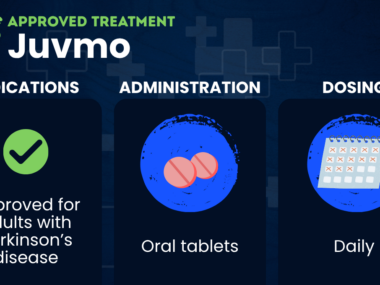
Vyalev, Abbvie‘s continuous under-the-skin infusion formulation of levodopa/carbidopa, reduces off time and eases motor and some nonmotor symptoms in adults with advanced Parkinson’s disease.
That’s according to six-month data from an ongoing real-world study, ROSSINI (NCT06107426), which also showed the therapy improves patients’ quality of life. The trial is evaluating Vyalev in routine clinical practice across 10 countries in 427 adults with advanced Parkinson’s who will be followed for up to three years.
“ROSSINI demonstrates reductions in motor fluctuations and nonmotor symptoms, and increased quality of life in patients with [advanced Parkinson’s disease] after [six] months of [Vyalev] treatment,” the researchers wrote. “The safety profile was consistent with clinical trials.”
The interim data were published in Neurology and Therapy in an Abbvie-funded study titled, “Real-World Safety and Effectiveness of 24-Hour Foslevodopa/Foscarbidopa in Parkinson’s Disease: ROSSINI Study 6-Month Interim Results.”
Parkinson’s disease is caused by the progressive loss of brain cells that produce the signaling molecule dopamine, resulting in Parkinson’s symptoms that most commonly affect movement and balance. A mainstay Parkinson’s treatment is oral levodopa, a precursor of dopamine that’s usually given together with carbidopa, a medicine that allows more levodopa to reach the brain and be converted into dopamine.
Maintaining levodopa
Levodopa/carbidopa therapy is usually effective at controlling symptoms. However, many patients eventually develop motor fluctuations, when motor symptoms return between scheduled doses during periods known as off episodes. Long-term levodopa treatment may also lead to dyskinesia, or uncontrolled and involuntary movements.
Vyalev, sold as Produodopa in Europe and the U.K., is designed to continuously deliver foslevodopa and foscarbidopa via a specialized pump 24 hours a day. These are prodrug forms of levodopa and carbidopa, inactive molecules that convert to the active medications once inside the body. By maintaining more stable levodopa levels, the therapy aims to reduce off episodes and improve symptom control.
The therapy’s approval in the U.S. and other regions was largely based on findings from a randomized, controlled Phase 3 clinical trial (NCT04380142) and supported by data from an open-label, global Phase 3 trial (NCT03781167). In those studies, continuous foslevodopa/foscarbidopa infusion was deemed safe and more effective than oral carbidopa/levodopa at controlling Parkinson’s symptoms in those with advanced disease. Participants who completed the trials could enroll in long-term extension studies.
“Nevertheless, robust real-world (RW) evidence surrounding the effectiveness of [Vyalev] among patients with [advanced Parkinson’s disease] is lacking due to its only recent availability,” the researchers wrote.
The international team of researchers launched ROSSINI to capture the real-world impact of Vyalev. The observational study recruited adults with advanced Parkinson’s who were starting the therapy as part of routine clinical care, as well as some who transitioned from open-label extension studies of earlier Phase 3 trials.
This interim analysis focuses on six-month findings from 105 adults with advanced Parkinson’s who were new to Vyalev. Slightly more than half of the participants (56.2%) were men, with a mean age of 68.5. At study entry, participants had been living with Parkinson’s for a mean of 12.1 years and had an average of 5.2 hours of daily off time.
At the time of the analysis, 34 participants (32.4%) had discontinued treatment, including 29 (27.6%) who stopped therapy within the first six months. The most common reasons included patient withdrawal (14.3%), side effects (9.5%), and lack of efficacy or unmet expectations (3.8%).
Among participants who remained on treatment and had evaluable six-month data available, daily off time was reduced by a mean of 2.8 hours, or about 53%. Daily dyskinesia time also decreased by 1.8 hours, or about 53%.
Treatment was associated with significant and clinically meaningful reductions in motor symptoms, as reflected in lower scores on the Movement Disorder Society-Unified Parkinson’s Disease Rating Scale Part III, a standard measure of Parkinson’s motor symptoms such as tremor, stiffness, slowed movement, and balance problems.
Freezing of gait, a feeling of being temporarily unable to move while walking, lessened significantly over the six months.
Vyalev also significantly eased several nonmotor symptoms associated with Parkinson’s, including pain, sleep disturbances, and gastrointestinal dysfunction. Quality of life, as assessed through the Parkinson’s Disease Questionnaire-39, also improved over the six months, particularly in domains related to mobility, emotional well-being, and bodily discomfort.
Of the 105 participants included in the safety analysis, more than half (55.2%) experienced at least one adverse event, although most were mild to moderate. In line with previous clinical trials, hallucinations and infusion-site infections were the most commonly reported side effects, each affecting 5.7% of patients.
Serious adverse events occurred in 13 participants (12.4%). Two deaths were reported during the study, but both were deemed unrelated to treatment.
“Interim results from the ROSSINI study provide the first prospective [real-world] data for [Vyalev], showing reductions in motor complications and nonmotor symptoms, and increased [quality of life] with [six] months of treatment,” the researchers concluded, adding that “a second interim analysis will be conducted on 200 patients with at least 12 months of follow-up.”



Susanna power
Its wonderful newst vyalev has proved to be positive treatment for advanced Parkinson’s. The not so wonderful news is that MANY patients cannot try the treatment due to the cost of the medication. I am one of those patients.
Monica McMahon
infusion-site infections were the most commonly reported side effects
Why does this happen and how do I manage this symptom ?
MARGARIDA LOPES
I was for almost 6 years on Apomorphine Infusion and last year 12/05/2025 finished and star Produodopa Vyalev and honestly don't like the way problems start development. After exactly one month i've been started tryed suicide one of side effects 12/06/2025 , started having psicotic episodes, allucinations, ilusions, and the hospital keep me for 11 weeks inside with no tests to see if were produodopa or not. a few weeks later started development symptoms Neuropathy Perifereal until now only last april made me a conduct nerve studies and confirmed Neuripathy and after this exam went to done blood tests, today 27/052026 don't know the results and the only thing i know is almost can;t walk.