
New data back safety of treatment to replace lost Parkinson’s nerve cells
First-in-human study findings at 1 year support therapy's development
Written by |
- In a small clinical trial, a stem cell therapy for Parkinson's was shown to be generally safe, backing its continued development.
- The treatment, called STEM-PD, aims to replace the nerve cells that are lost in Parkinson's.
- After one year, investigators reported early signs of motor improvement among participants.
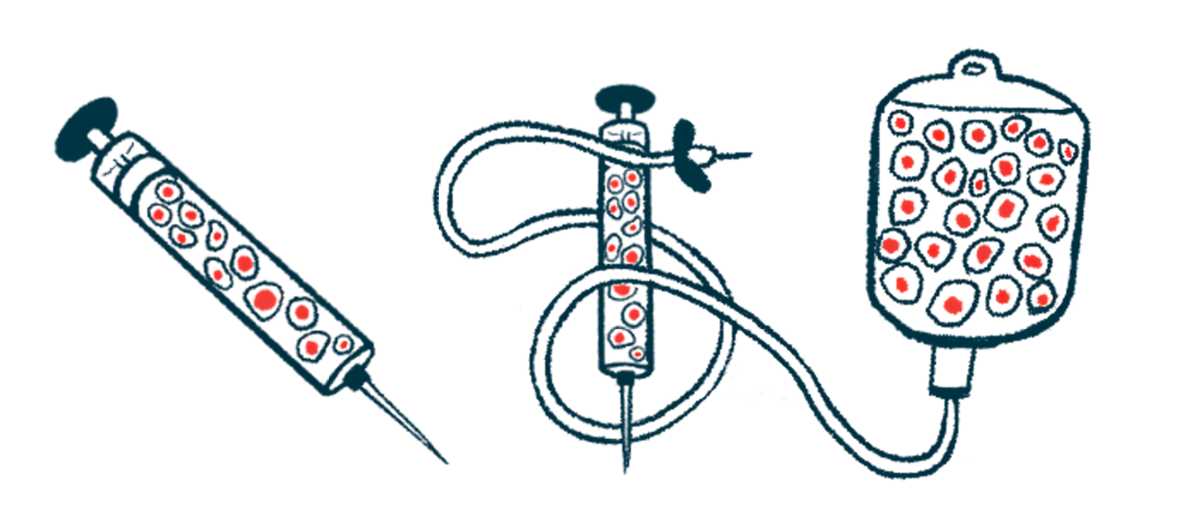
An investigational stem cell-based therapy that would replace the nerve cells, or neurons, lost due to Parkinson’s disease was found to be generally safe and feasible for use after one year of study in a first-in-human clinical trial — results the researchers say support the treatment’s continued clinical development.
The newly reported findings are from a small study in Europe that tested the safety and preliminary effectiveness of the cell therapy STEM-PD. Scientists from Lund University in Sweden discovered that their treatment candidate could potentially be regenerative, meaning it might develop into the dopamine-producing neurons lost in Parkinson’s.
The Phase 1/2 study (NCT05635409) involved eight patients with moderate Parkinson’s, ages 50 to 75, who received the treatment at sites in Sweden and the U.K. The participants are being followed for up to 36 months, or three years.
The early data are promising, according to investigators, who noted signs of improvement among participants in addition to the positive safety data that was the study’s main goal.
“Reaching this primary endpoint and being able to show that the cell product is safe is a great achievement for this trial, our team, the participating patients [and] also for all patients suffering from Parkinson’s disease,” Gesine Paul-Visse, MD, PhD, professor and principal at Skåne University Hospital, said in a university news story detailing the findings.
“We are hopeful that the early signs of cell survival and clinical improvement we observe will continue to increase over … time,” Paul-Visse said, adding that the scientists are “excited to continue the development of this cell therapy.”
The study, “Human embryonic stem cell-derived dopaminergic cells for Parkinson’s disease: a phase 1/2 open-label trial,” was published in the journal Nature Medicine. It was conducted by researchers at Skåne in Sweden, in collaboration with Novo Nordisk.

Parkinson’s is caused by the progressive loss of dopaminergic neurons, the nerve cells that produce the signaling molecule dopamine. That loss drive the disease’s motor symptoms, such as tremor and problems with walking.
Current treatments, including levodopa, work to ease the disease symptoms by increasing dopamine levels. However, over time, these medications often become less effective and cause side effects like dyskinesia, or involuntary movements.
STEM-PD is a cell therapy developed at Lund that uses human embryonic stem cells that are programmed in the lab to become precursors of dopaminergic neurons. These cells are then surgically transplanted directly into the putamen, a brain region affected in Parkinson’s, where they’re expected to develop into healthy dopaminergic neurons.
“The possibility of replacing dopamine neurons that are lost in Parkinson’s disease has been a long-standing goal in the field,” said Malin Parmar, PhD, a neuroscience professor at Lund and leader of the STEM-PD program. “The findings represent an important milestone for regenerative medicine approaches in Parkinson’s disease and support continued clinical development of stem cell-based therapies.”
Scans show transplanted cells survived for 1 year after surgery
In the Phase 1/2 trial, participants received STEM-PD at two doses (3.5 and 7.1 million cells per putamen), followed by one year of immunosuppressive treatment to prevent rejection of the cells. Altogether, the participants had a median age of 63, had been living with the disease for a median of 14.5 years, and were mostly men (75%).
According to the team, data to date show the treatment has been generally safe and well tolerated, without causing dyskinesia. Three patients experienced serious adverse events, such as a transient worsening of Parkinson’s symptoms and visual hallucinations. A pulmonary fungal infection in one patient resulted in that individual’s death. While these effects were not attributed to the cell product itself or the surgical delivery, the researchers noted that opportunistic infections could be associated with the required one-year immunosuppression regimen.
Imaging scans indicated that transplanted cells survived for six and 12 months after the surgery. Also, six of the seven participants who completed one year of follow-up substantially reduced their dopaminergic medication, particularly the levodopa-equivalent dose — a standardized measure of the total daily Parkinson’s medication burden — by as much as 27.5%.
In the off-medication state, the patients’ motor function improved after one year for for participants, as measured by the Movement Disorder Society-Unified Parkinson’s Disease Rating Scale (MDS-UPDRS) Part 3. Specifically, gains were seen for three participants in the low-dose group and one in the high-dose group. MDS-UPDRS Part 3 scores during the on-medication state remained stable over one year, the researchers noted.
Nonmotor symptoms, cognitive performance, depression markers, and health-related quality of life remained stable after one year, the data showed.
The STEM-PD trial … has enabled us to undertake and deliver on one of the first ever stem cell-derived dopamine cell therapies for patients with Parkinson’s and we hope this will be the beginning of an exciting new programme that may ultimately benefit the wider Parkinson’s community.
Roger Barker, MD, PhD, a professor at the University of Cambridge who serves as clinical lead of STEM-PD and principal investigator at the UK site, said the treatment’s development “represents an exciting new [step toward] repairing the brain of individuals with Parkinson’s using dopamine cells.”
“The STEM-PD trial … has enabled us to undertake and deliver on one of the first ever stem cell-derived dopamine cell therapies for patients with Parkinson’s and we hope this will be the beginning of an exciting new programme that may ultimately benefit the wider Parkinson’s community,” Barker said.
Cellular Intelligence has recently acquired the STEM-PD program and will be responsible for its next phase of clinical development, including a planned Phase 2 trial.

Leave a comment
Fill in the required fields to post. Your email address will not be published.